Tuesday, December 4, 2007

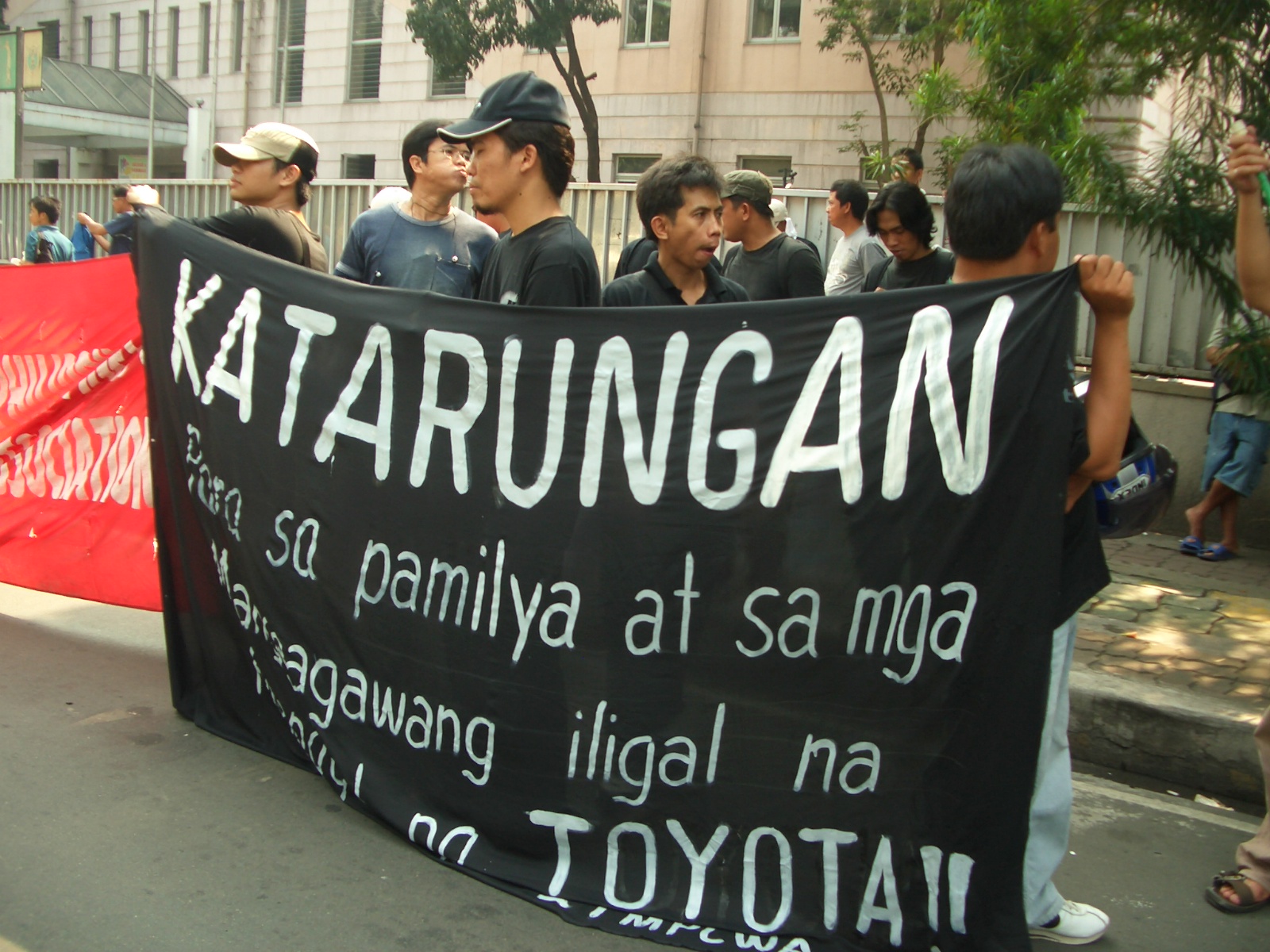
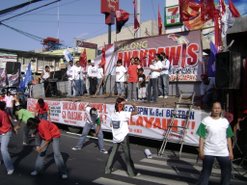
Kilos - Protesta sa Harap ng Toyota

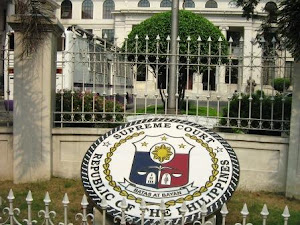
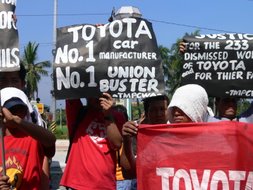
Naglunsad ng kilos-protesta ang TMPCWA sa harapan ng planta ng Toyota Sta. Rosa Laguna ang TMPCWA noong ika-23 ng Nobyembre upang mahigpit na kondenahin ang matinding sabwatan ng kapitalistang Toyota at ng 2nd Division ng Korte Suprema sa Masscre Decision.

Kinukundena ng mga manggagawang iligal na tinanggal ang desisyon ng Korte Suprema dahil sa hindi makatao at hindi makatarungan at labag sa Saligang Batas ng Pilipinas.

Sinalaula ng 2nd Division ng Korte Suprema sa pangunguna ni Justice Prisbetero Velaso ang Saligang Batas ng Pilipinas kung saaan nakasaad ang umiiral na batas sa FREEDOM OF EXPRESSION AT FREEDOM OF ASSOCIATION. Mas binigyang bigat at mas kinilala ang isang Company Rules and Regulation na anti-manggagawa at anti-konstitusyon ni Velasco para lamang pagbigyan ang mga kapritso ng Toyota.

Pinaniniwalaang ang desisyon ng 2nd Division ng Supreme Court ay layunin na pigilin ang ibayong paglawak at patuloy na pakikiisa at mahigpit na suporta ng INTERNATIONAL SOLIDARITY. Layunin din ng desisyon na was akin ang mahigpit na ugnayan at pagkakaisa ng mga manggagawang iligal na tinanggal at mga manggagawang kasapi ng TMPCWA na nasa loob ng Toyota. Higit layunin ng desisyon na was akin ang militanteng pagkilos ng buong kilusang manggagawa.

Napagalaman na ang Back Ground ng mga huwes ng 2nd Division na responsible sa Masscre Decision sa pangunguna ni Velasco na bagong itinalaga ni Gloria Arroyo at dating Company Lawyer mula sa Cavite. Si Quisumbing na dating Secretary of Labor. Si Dante tinga na dating Congressman at itinalaga din ni Gloria Arroyo. Sina Antonio Carpio at Conchita Carpio Morales ay mga katulad din nilang pro-kapitalista. Kayat walang aasahan ang mga manggagawa sa 2nd division ng Korte Suprema.

Magkagayunman, hindi titigil ang mga manggagwa ng Toyota, higit ng mga manggagawng iligal na tinanggal upang ipagpatuloy ang pakikibaka para kamtin ang tunay na hustisya. Magpapatuloy ang mga pagkilos at pagkundena sa mga hindi makatao at hindi makatarungang sabwatan ng 2nd Dision ng Korte Suprema at ng ganid na kapitalistang Toyota.

TULUY-TULOY NA ILANTAD AT LABANAN ANG SABWATANG GANID NA TOYOTA AT NG 2ND DIVISION NG KORTE SUPREMA!

PINAKAMATAAS NA ANYO NG PAGKONDENA SA MASSACRE DECISION NG 2ND DIVISION NG KORTE SUPREMA!

PINAKAMATAAS NA PAGKONDENA SA ANTI-MANGGAGAWA AT GANID NA KAPITALISTANG TOYOTA!

Monday, December 3, 2007


KATARUNGAN PARA SA MGA MANGGAGAWA NG TOYOTA AT MGA PAMILYA!

Ang BATAS ay nilikha upang bigyang proteksyon ang karapatan ng bawat nilalang, hindi para maglingkod sa interes lamang ng iilan.

Taliwas sa kaso ng mga manggagawang iligal na tinanggal ng Toyota, nang maglabas ng isang makaisang panig na desisyon ang Korte Suprema, sa diumano’y Illegal Strike/ Illegal Dismissal na kaso na may G.R. Nos. 158789/ 158798, noong ika-19 ng Oktubre 2007.

WHEREFORE, the petitions in G.R. Nos. 158786 and 158789 are DENIED while those in G.R. Nos. 158798-99 are GRANTED.

The June 20, 2003 CA Resolution in CA-G.R. SP Nos. 67100 and 67561 restoring the grant of severance compensation is ANNULLED and SET ASIDE.

The February 27, 2003 CA Decision in CA-G.R. SP Nos. 67100 and 67561, which affirmed the August 9, 2001 Decision of the NLRC but deleted the grant of severance compensation, is REINSTATED and AFFIRMED.

No costs.

SO ORDERED.

PRESBITERO J. VELASCO, JR.

Associate Justice

MASSACRE; ito ang pagsasalarawan ng mga manggagawang iligal na tinanggal, sa desisyon ng Korte Suprema. Walang katarungan at napakahalata; na ang pinagsisilbihan lamang ng deisyon, ay ang dayuhang multi-nasyunal at trans-nasyunal na dambuhalang korporasyong Toyota.

Walang ni-katiting na argumentong pinakinggan ang Korte Suprema, mula sa 227 manggagawang iligal na tinanggal ng Toyota. Ang bawat piraso ng makapal na bilang, na may apatnapu’t syam (49) na pahinang desisyon, ay parang talim ng isang tabak, na isa-isang humihiwa, sa katawan ng mga manggagawa at kanilang mga pamilya, kung babasahin ang nilalaman ng Massacre na desisyon.

Sa dalawang mayor na puntong kinakailangang mabigyan ng patas at makatarungang pagsusuri, tila ba pinaggigilan pa ng mga huwes, ang walang kalaban-laban na mga manggagawa. Animo’y may malaking pagkakasala sa mga Hurado ang mga manggagawa, upang paghigantihan at gamitin ang natutunan ng mahabang panahon sa pagsusunog ng kilay. Muling isinalang sa hasaan ng gulok ang kaisipan hanggang sa maging isang KILLER DECISION.

Ang tunay at makatotohanang mga argumento ng unyon, na walang paglabag at hindi iligal ang mga naging pagkilos ng mga manggagawa, sa ibat-ibang okasyon, ay pinilit baluktutin at dinistrungka ng Korte Suprema. Hindi lamang kinopya, sa halip ay dinagdagan pa ng Korte Suprema, ang mga paratang sa laman ng Petisyon ng Toyota, laban sa mga manggagawa.

Kalkalin natin ang laman-laman ng ala-massacre na decision ng Korte Suprema at subukang sagutin ng katotohanan mula sa tunay na mga pangyayari na inihapag lahat ng mga manggagawa, subalit hindi man lang nilingon ng may tapa-ohong takip sa mata ng mga hurado ng 2nd Division:

Sabi ng 2nd Division; Illegal Strike ang naging pagkilos ng mga manggagawa ng Toyota, noong February 21, 22, 23, 2001, nang magtungo ang mga manggagawa sa Bureau of Labor Relations – Department of Labor and Employment (BLR-DOLE), sa mga batayang; Una, walang Notice of Strike and Unyon. Hindi sinunod ng Unyon ang mga kailangang rekisitos, bago maglunsad ng isang welga, tulad ng pag-Apply ng Notice of Strike, paglulunsad ng Strike Vote, at pagpapasa ng resulta ng Strike Vote sa DOLE.; Pangalawa, hindi kumuha ng PERMIT to RALLY ang unyon sa City hall ng Manila.; Pangatlo, Nilabag ng Unyon ang Patakaran at Regulasyon ng Kumpanyang Toyota.

Ang tunay na kaganapan sa okasyong ito; noong February 21, 2001 ay nagpatawag ng isang Clarificatory hearing ang BLR, upang dinigin ang apela ng Toyota sa desisyon ng Med-Arbiter at ng Under-Secretary ng DOLE, na ang Unyon - Toyota Motor Philippines Corporation Workers Association (TMPCWA) na isa ng ganap na Sole and Exclusive Bargaining Agent (SEBA), sa lahat ng rank and file ng Toyota. Hindi natapos ang ipinatawag na Hearing ng BLR, kaya nagtakda muli ng isa pang araw noong February 22 at muling naulit ng February 23, 2001 na dinaluhan ng mga manggagawa, upang magbantay sa maaring gawing hindi patas na pagdinig ng BLR.

Argumento ng Unyon; Una, paano kakailanganin ang Notice of Strike at maglulunsad ng Strike Vote at maipapasa ang resulta sa DOLE, samantalang ang araw na ito ay HEARING na ipinatawag mismo ng BLR-DOLE? Katunayan may imbitasyon mula sa BLR ang Unyon gayundin ang Toyota. Lahat din ng dumalo sa Hearing sa hanay ng Unyon ay pinayagan ng Toyota, at naka-Vacation Leave.; Pangalawa, paanong kakailanganin ang isang Permit to Rally, gayung Hearing nga ang dinadaluhan ng mga manggagawa. Isa pa, malinaw sa sinasaad ng sagradong pahina ng Saligang Batas ng Pilipinas, ang malayang pagpapahayag (Freedom of Speech at freedom to Assemble), gayundin ang pagkilala sa karapatan ng mga manggagawa, sa malayang pag-tatayo ng Unyon.; Pangatlo, hindi kayang saklawan ng isang Company Rules and Regulations ang Pinakamataas na batas ng Konstitusyon, na kumikilala sa karapatang mag-unyon, na nais namang supilin ng Toyota.

Sabi ng 2nd Division; Illegal Strike ang welga ng mga manggagawa noong March 28 hanggang April 12, 2001 at isinama rin ang mga araw mula March 17 hanggang April 12. Una, dahil kahit pa sinunod ng Unyon ang lahat ng rekisitos na ipinapatupad ng DoLE, ay nilabag naman ng mga manggagwa ang Temporary Restraining Order, sa Free Ingress To And Egress From o pagharang sa mga Gate ng Kompanya.; Pangalawa, ang mga larawan na ipinakita ng Toyota sa Korte Suprema, ay walang dudang may ginagawang pananakot ang mga manggagawa.; Pangatlo, ipinakita ng AFFIDAVIT o Sinumpaang Salaysay ang masamang salitang sinabi ng manggagawa na BAKERU!.

Ang katotohanan; Iligal na tinanggal ng Toyota ang mahigit 300 kasapian at mga lider ng Unyon, noong March 16, 2001, kasabay ng araw na inilabas ng Department of Labor, ang pinal na desisyon, na ang Unyon (TMPCWA) ay isa ng ganap na SOLE and Exclusive Bargaining Agent, para sa lahat ng manggagawang rank-n-file ng Toyota. Sa kabila ng pagtatanggal sa manggagawa, naging makatarungan pa rin ang Unyon. Sinikap na abutin ng Unyon ang Manedsment, upang ibalik ang mga manggagawang iligal na tinanggal. Sa loob ng dalawang linggo, hindi nakipagusap ang Toyota. Walang nagawa ang unyon kundi’ idepensa ang mga manggagawang iligal na tinanggal at ipinutok ang welga noong March 28, 2001.; Pangalawa, hindi totoong hinarangan ng mga manggagawa ang Gate ng Toyota sa panahon na may TRO. Ang mga larawan na ipinakita ng Toyota ayon sa desisyon ng Korte Suprema na may isang manggagawa na nakaharang sa isang gate at tatlo naman sa isa pang Gate. Paanong kakayaning harangin ng isang manggagawa o tatlong manggagawa ang tag-isang gate ng kompanya? Kapag hinarang ito kahit pa limang tao, isang sagasa lamang ng sasakyan ng Toyota ay kayang hawiin o mabuwag ang mga manggagawa, kaya saan hinugot ng Korte Suprema ang kanyang pagsusuri sa mga pangyayari?; pangatlo, paanong binigyan ng halaga ng Korte Suprema ang isang Affidavit, samantalang hindi man lang ito dumaan sa isang Cross-Examination, at hindi man lang napatunayan kung sino man ang mga tinutukoy na tao at toong kung may nagbitaw ba ng masamang salita? Napaka-garapal naman yata?

Sabi ng 2nd Division; Illegal Strike ang pagkilos ng mga manggagawa noong May 23 at 28, 2001. Una; dahil kahit naka-Pay-Roll Reinstated o ibinalik lang sa pamamagitan ang manggagawa, subalit hindi ibinalik sa pagawaan, at magprotesta sa harap ng Kumpanya ay labag sa batas. Nilalabag ng manggagawa ang Assumption Order na inilabas ng Seretary of DoLE na si Patricia Sto. Tomas.; Pangalawa, makakalikha pa ng posibleng kaguluhan ang protesta sa mga manggagawang nasa loob ng kumpanya.

Ang katotohanan; noong May 23 at 28, 2001, walang naganap na welga. Hindi rin nag-DEFY ang Unyon sa Assumption Of Jurisdiction (A/J) na inilabas ng DoLE.; Una, ang inilabas na Assumption Order (I/O) ni Sto. Tomas ay espesyal at ang nilalaman ay napakagarapal at paborable sa Toyota. Ang A/J I/O ay Return to Work Order, galing sa Secretary of DOLE. Kautusan ng Kalihim ng Paggawa na pahintuin ang welga at pabalikin ang mga manggagawa sa trabaho. Subalit, isang espesyal na AJ ang ang ibinigay ng DOLE sa Toyota ng ilagay ni Sto. Tomas sa kanyang kautusan ang lahat ng karapatan sa Toyota management, na pumili kung sino lamang ang pababalikin at ang hindi. Hindi pinabalik ng Toyota ang 227 at inilagay lamang sa Payroll Reinstatement.

Noong May 23, 2001, araw ito ng sweldo. Araw din ng 227 na kuhain ang mga pay-slip sa gate ng Toyota. Ginamit ng Toyota ang Araw na ito at buong kasinungalingan na ginamit sa DOLE-NLRC na iligal na nagwelga ang mga manggagwa. Hindi nakuha ang mga payslip ng mga manggagawa, at inilipat ng araw ng May 28, 2001. Pinaghandaan ito ng Toyota at nilagyan ng desenyo para pwersahang buwagin ang mga manggagawang kumukuha lamang ng mga Payslip sa hudyat ng pagpapaputok ng Shot-Gun ng gwardya ng tatlong beses. Marahas na pinagpapalo at ginulo para buwagin ang planadong atake ng Toyota sa mga manggagawa. Hindi ito binigyan ng pansin ng Korte Suprema.

Kahit katiting ay hindi binigyan ng konsiderasyon ng Korte Suprema kung bakit nagkaroong ng mga pagkilos ang mga manggagawa. Hindi man lang nangahas ang Korte Suprema na kahit patay-malisya na sagiin, na kaya nagwelga ang mga manggagawa ay may Union Busting, na ginawa ang Toyota, sa malawakang iligal na tanggalan sa 227 manggagawa, na lahat ay kasapi at mga lider ng Unyon. Ni-hindi man lamang natisod ang Korte Suprema. Hindi man lang nagbanggit ang Korte Suprema, Kahit man lang pabulong sa kanyang desisyon, na hindi kinilala ng Toyota ang mga desisyon ng DOLE, na kumikilala sa rekognisyon ng unyon, bilang lehitimong Unyon na may moral at legal na batayan, para maglunsad ng mga protesta.

NASAAN ANG KATARUNGAN SA DESISYON NG KORTE SUPREMA?

Pitong taon mahigit, matiyagang hinintay ng mga manggagawa ang magiging desisyon. Umaasang pakikinggan ng Korte Suprema ang mga argumentong inihapag ng Unyon. Umaasang mabibigyan ng katarungan ang pitong taon, na pagtitiis sa kabila ng kawalang hanap-buhay. Umaasang mabibigyan ng katarungan ang anim (6) na mga anak ng mga manggagawang namatay, dulot ng kahirapan. Umaasang mabibigyan ng katarungan ang isang kasaping namatay dahil sa pagkakasakit habang nagpapatuloy sa paglaban. Umaasang mabibigyan ng katarungan ang mga pamilyang winasak, dulot ng tanggalan. Umaasang ang mga materyal na bagay, na nawala sa mga manggagawa, ay maibabalik kahit hindi lahat. Higit, umaasa na mabibigyan ng katarungan, ang dignidad ng mga manggagawang mas pinili na ipaglaban, ang pundamental na karapatan nila bilang manggagawa. Umaasang hanggang sa huli ay mabibigyan ng katarungan, na maitayo ang isang Tunay na unyon, na magsisilbi sa tunay na interes ng mga manggagawa sa loob ng mahigit labing limang (15) taon ng pakikibaka.

Sa paghihintay ng desisyon, kasabay ng walang humpay na pakikibaka. Umani ng malawak na suporta ang Unyon-TMPCWA. Hindi lamang sa loob ng Pilipinas, kundi’ sa maraming bansa. Kinilala ang dakilang pakikibaka ng mga manggagawa ng International Solidarity at ang nagging tuntungan ay ang Desisyon ng Korte Suprema noong September 24, 2003 at January 28, 2004 na nag-uutos sa Toyota, para simulan ang CBA negotiation. Hanggang sa kasalukuyan hindi ipinatupad ng Toyota ang kautusan ng pinakamataas na hukuman. Maging ang rekomendasyon ng International Labor Organization ay hindi pinakinggan ng Toyota.

Dahil sa mga pangyayaring ito, malakas na boses ng International Solidarity ang umalingawngaw sa mundo. Inilunsad ang International Day of Protest, laban sa anti-manggagawang patakaran ng Toyota. Nilahukan ito ng apatnapu’t apat (44) mga bansa na may pitumpu’t pitong (77) organisasyon at mga global na organisasyon sa buong mundo. Sabay-sabay na naglunsad ng kilos-protesta sa harap ng Japanese Embasy ng 44 na bansa noong September 12, 2006. Nasundan pa muli ng International Global Day of Protest Against Toyota noong September 12, 2007. Maraming mga sulat-protesta ang natanggap ng Toyota at ng DOLE.

Bilang ganti ng Toyota at ng Department of Labor Secretary patricia Sto. Tomas at Bagong Secretary Arturo Brion, sa malawakang suportang inaani ng mga iligal na tinanggal at ng unyon-TMPCWA. Magkasabwat nilang nilikha ang dilawang Unyon sa Toyota. Agad na kinilala ng Toyota ang kanyang isponsor na unyon na Toyota Motor Philippines Corporation Labor organization at mabilis na tinapos ang CBA.

Hindi katulad ng KILLER Desisyon ng Supreme Court, nais ng TMPCWA, na ilabas ang tunay na katotohanan sa distrungkadong LEGAL SYSTEM ng Pilipinas. Nais nating ipakita kung ano ang aasahan sa ganitong sistema, sa ilalim ng lipunan na ang umiiral at pinaglilingkuran ay ang kapangyarihan lamang ng naghaharing uri sa kabuuan.

Inilabas ang Supreme Court Decision, para i-Massacre hindi lamang ang Unyon-TMPCWA at ang mga manggagawa at pamilya ng mga manggagawang iligal na tinanggal. Sa halip, nais ng mga nagdidikta para mabuo ang desisyon para tiyakin na ang sasapulin ay ang buong kilusang paggawa sa kabuuan. Napakapulitikal ng desisyon. Nais ng Toyota na ibalibag sa International Solidarity ang Supreme Court Decision, para matigil na ang lumalawak na International Support ng Unyon, na malaking banta sa pamamayagpag ng Toyota bilang bagong hari ng mga CAR Companies sa buong mundo.

Hindi maikakaila, na may kinalaman ang Rehimeng Gloria Arroyo, sa paglabas ng MASSACRE Decision. Walang takot nating ilantad kung paano at bakit natin sinasabi ito;

xxx GMA receives RP's first-ever 'hybrid' sedan

By Carlito Pablo

October 11, 2002

Page A1 (PHILIPPINE DAILY INQUIRER)

THE FIRST-EVER "hybrid" sedan in the country that runs on both electric and gasoline power was presented to President Macapagal-Arroyo yesterday.

Toyota president Fujio Cho turned over the key of a light aqua environment-friendly Toyota Prius to President Macapagal when she visited the car firm's plant in Sta. Rosa, Laguna.

Valued at $20,000 including taxes, the Prius is available only in Japan, the United States and some parts of Europe. Xxx

SEPTEMBER 2001 SPEECH NI GMA SA PAGPUNTA SA JAPAN

WE ARE DETERMINED TO IMPROVE OUR COMPETITIVENESSALSO BY MINIMIZING LABOR DISPUTES. THE DEPARTMENT OF LABOR AND THE DEPARTMENT OF TRADE HAVE FORMED QUICK REACTION TEAMS TO PRO-ACTIVELY ASSIST IN SETTLING LABOR-MANAGEMENT DISPUTES BEFORE THEY DEVELOP INTO CONFRONTATIONAL SITUATIONS. BECAUSE OF THIS CONCILIATION AND MEDIATION OF THE DTI AND THE DEPARTMENT OF LABOR MORE THAN 400 ANNOUNCED STRIKES DID NOT ACTUALLY TAKING PLACE-BECAUSE RECONCILIATION WAS MADE BY THE INTERVENTION OF THE GOVERNMENT. RECENTLY, OUR ARBITRATION COURT RESOLVED A LABOR DISPUTE IN FAVOR OF TOYOTA-PHILIPPINES MANAGEMENT.

Xxx SEPTEMBER 14, 2001 (P2-PHILIPPINE DAILY INQUIRER)

STAY IN RP, GLORIA ASKS JAPANESE

TOKYO – (via – PLDT) – President Macapagal-Arroyo practically begged Japanese businessmen to keep their investments in the Philippines, saying the country was willing to do all it could to protect them and their investments.

“ We will do what we need to do… to make you successful and globally competitive because we want you to stay with us,” Ms Macapagal said at the end of her speech during a luncheon with the Philippines-Japan Economic Cooperation at the Hotel New Otani here.

“We call on the Japanese companies, especially those already in the Philippines to be with us as the new government embarks on a journey into the new economy of the new century,” she said.xxxx

ALAM NG TOYOTA, ALAM NG MGA MANGGAGAWA, KUNG SINO ANG TUNAY NA MAY SALA!

Ang MASSACRE NA DESISYON, ay hindi kayang igupo ang Unyon, kahit pa nagmula sa pinakamataas na hukuman ng Korte Suprema, sapagkat, ang pakikibaka ng mga manggagawa ng Toyota, kabilang na ang mga pamilya ng mga manggagawang iligal na tinanggal ay napakadakila.

PATULOY NA SUPORTAHAN ANG DAKILANG PAKIKIBAKA NG MGA MANGGAGAWA NG TOYOTA!

PINAKAMALAKAS NA PAGKONDENA SA MALA-MASSACRE NA DESISYON NG KORTE SUPREMA!

PINAKAMALAKAS NA PAGKONDENA SA TOYOTA!

KATARUNGAN PARA SA MGA ILIGAL NA TINANGGAL NG MGA MANGGAGAWA NG TOYOTA AT MGA PAMILYA!

Mabuhay ang mga manggagawa ng Toyota!

Mabuhay ang Uring manggagawa!

(mga karagdagang impormasyon)

PGMA's Speech during the Signing of the Memorandum of Understanding among the Conservation International Foundation, Toyota Motor Corporation, Department of Environment and Natural Resources and the Municipal Government of Peñablanca, Cagayan
Thursday, September 13, 2007
Rizal Hall, Malacañang


Maraming salamat sa ating bagong Secretary of Environment and Natural Resources, Secretary Lito Atienza.

Congressman Manny Bamba, the congressman of the 3rd District of Cagayan where Peñablanca is located; Doctor George Ty, Chairman of Toyota Motor Corporation; Okabe San, Managing Director; Mr. Prickett and Mr. Hess of Conservation International; Mayor Julia of Peñablanca; other local government officials of Peñablanca; other officers of Toyota; ladies and gentlemen.

Today, we move forward with all the stakeholders of the Peñablanca protected landscape and seascape -- with the full support of the people. This is another milestone towards Green Philippines.

Toyota Motor, the biggest automaker in the world, as Mr. Okabe said, is funding this six-year project with a grant of 350 million yen. Thank you, Toyota.XXX

XXX I want to congratulate the 3rd District of Cagayan and the municipality of Peñablanca, and thank Toyota and Conservation International for being an important part of the new Philippines.

We hope that other global citizens will invest in our environment, following the lead of Toyota Motors Corporation and Conservation International.XXX

XXX PGMA leads groundbreaking rites of Toyota expansion plant in Laguna (MARCH 15, 2007)

STA. ROSA CITY, Laguna – President Gloria Macapagal-Arroyo led today the groundbreaking of Toyota Autoparts Philippines’ (TAP) R-type transmission plant, part of the company’s fresh P5.6-billion expansion investment in the Philippines for its production and export of manual transmissions. XXX

TMPCWA MANIFESTO


JUSTICE FOR THE ILLEGALLY DISMISSED WORKERS OF TOYOTA AND THEIR FAMILIES!

The LAW was created to protect the rights of humanity, and not to serve the interest of a few.

Contrary to the case of the workers illegally dismissed by Toyota, when the Philippine Supreme Court released a one-sided decision, in the alleged Illegal Strike / Illegal Dismissal case with G.R. Nos. 158789/ 158798, last 19 October 2007.

WHEREFORE, the petitions in G.R. Nos. 158786 and 158789 are DENIED while those in G.R. Nos. 158798-99 are GRANTED.

The June 20, 2003 CA Resolution in CA-G.R. SP Nos. 67100 and 67561 restoring the grant of severance compensation is ANNULLED and SET ASIDE.

The February 27, 2003 CA Decision in CA-G.R. SP Nos. 67100 and 67561, which affirmed the August 9, 2001 Decision of the NLRC but deleted the grant of severance compensation, is REINSTATED and AFFIRMED.

No costs.

SO ORDERED.

PRESBITERO J. VELASCO, JR.

Associate Justice

MASSACRE; this is how the illegally dismissed workers described the Supreme Court decision. Very unjust and evidently serving the one-sided interest of the multi-national and trans-national Toyota Corporation.

Not even a single argument from the 227 illegally dismissed workers was heard by the Supreme Court. Each pieces of the thick decision with 49 pages; is like a sharp-edged knife that slices deeply into the worker’s body and their families, when you read the contents of the Supreme Court’s Massacre decision.

In the two major points that the Supreme Court should have given a fair and just analysis, it seems that the panels of judges have a vendetta with the illegally dismissed workers. The judges made it seems that the workers committed the most heinous and deplorable crime that they already passed judgment without considering the side of the workers. The sharpness of their mind may prove fatal for the worker’s plight and be remembered as the KILLER DECISION.

The workers firmly stands on their argument on the truth that not a single violation and illegal actions was committed on the peaceful protest actions on all occasions and that the facts are being distorted and misconstrued by the Supreme Court. What is evident is that the Supreme Court justices merely copied and added a few arguments on the allegations written on the petition of Toyota Corporation against its workers.

Let us look into the massacre decision of the Supreme Court and try to answer truthfully, based on actual facts and events that was raised in the petition of the workers, but the justices of the 2nd Division of the Supreme Court, seems to have blindedly ignored.

The 2nd Division said that the action made by the workers on February 21, 22 and 23 of 2001 in front of the office of the Bureau of Labor Relations (BLR-DOLE) is considered an illegal strike, based on three grounds: One, the Union did not filed for a Notice of Strike. The Union did not secured the necessary requirements before launching a strike; such as, the application of the Notice of Strike, a strike vote, and submission of the strike vote result to the Department of Labor and Employment (DOLE). Second, the Union did not secured a Permit to Rally at the Manila City Hall. And last, the Union violated the company rules and regulations of Toyota Philippines.

The truth of the matter is that on February 21, 2001, the BLR called for a clarificatory hearing on the appeal made by Toyota on the two decision released by the Med-Arbiter and Undersecretary of the DOLE, recognizing that Toyota Motor Philippines Corporation Workers Association (TMPCWA), is the sole and exclusive bargaining agent (SEBA) for all the rank-n-file workers of Toyota. A handful of officers and workers filed their respective leave to attend the hearing. The clarificatory hearing was reset on February 22 and 23, 2001 as requested by Toyota management. The workers, sensing something unusual about it, attended to watch and guard the proceedings for any unfair actions by the BLR.

The Union’s Argument: First, why is it necessary for the Union to apply for a Notice of Strike and the requirements that goes along with the Notice of Strike, when they are just attending what the BLR itself called for, which is the clarificatory hearing. In fact, the BLR invited the Union and Toyota management. If Toyota did not meddled in the affairs of its workers and continued its dirty tactics in delaying the recognition of the Union by using loopholes in the Law, then the workers would not have been instigated into attending the clarificatory hearing. Secondly, why is it necessary to secure a permit to rally, when it is a clarificatory hearing that the workers are attending?. During that time, the law on “No Permit, No Rally” is not yet implemented, as Gloria Arroyo’s Regime was newly established by People Power 2. It is also enshrined in the sacred pages of the Philippine Constitution which clearly guarantees the constitutional rights of its people the freedom of expression (the freedom of speech and peaceful assembly), to recognize the rights of workers to freely establish and join the union and that company rules and regulations cannot overthrow the highest constitutional law of the land, recognizing the right to form a union, which Toyota wanted to suppress.

2nd Division said; the strike on March 28 to April 12 including March 17 to April 12 was illegal. Even though the Supreme Court said that the union secured all the requirements for a legal strike of the DOLE, they said that the workers violated the Temporary Restraining Order (TRO) on Free Ingress To and Egress From or the blocking of the gates of the company. Toyota showed some photos to which they used to collaborate their claim that the suppliers and company officials where threatened by the workers.

The truth behind this occasion: on March 16, 2001, the very same day the DOLE released its final decision that TMPCWA is declared as a SEBA, Toyota illegally dismissed some 300 members and officers of the union. Despite the illegal dismissal action of the company, the Union, in good faith, tried to negotiate with the management to reinstate the workers back to their work. In the two weeks that passed, Toyota ignored and disregarded the plea of the union. The Union decided that they have no choice but to defend their ranks by launching the strike on March 28, 2001. Second, the workers did not block the gates of the plants after the TRO. What was shown was a photo of a single worker standing in front of a gate, and another photo showing three workers standing in front of another gate. How can three men block a big gate, let alone a single person block a gate for vehicles passage by his lonesome? It is highly improbable for one or three, even five workers to block a gate unless they are chained in the gates which they are not, to block the gates of the company to prevent the vehicle from entering or leaving the plant. It can easily disperse the workers. Third, that the Supreme Court placed so much weight on a mere affidavit of a Toyota official that the Japanese officers were bad-mouthed by words such as “Bakeru”, which was not even submitted into a cross examination to determined its authenticity is clearly shameless.

The 2nd Division said: The action made by the workers on May 23 and 28, 2001 was an illegal strike also. The workers who are in payroll reinstatement and not physically reinstated was accused of staging an illegal action in front of the company’s plant. The workers violated the assumption order (Asumption of Jurisdiction) made by Patricial Sto. Tomas, the Secretary of DoLE. The action made by the workers in front of the company can create possible trouble for the workers inside.

The truth behind May 23 and 28, 2001, the Union did not launch any strike. The Union also did not violate nor defied the Assumption Order. First, the Assumption of Jurisdiction of Sto. Tomas is very favorable to the Toyota management. The Assumption Order is a “return to work order” based on the status quo but was given special treatment by allowing the company the option of choosing who will be reinstated and who are to be placed on the payroll reinstatement. There are some 227 workers placed on the payroll reinstatement.

May 23, 2001, is a payday for Toyota workers. The same day for the 227 payroll-reinstated workers to gather in front of Toyota to get all their pay-slip. The workers were not able to get their pay-slip because Toyota transferred the day of the distribution on May 28, 2001. This was a ploy made by Toyota to orchestrate a well-planned design to create an atmosphere of animosity. The guards forcibly dispersed the payroll-reinstated workers by striking them with nightsticks when they heard a shot from a shotgun three times into the air by a guard, obviously as a signal for the attack to begin.

The Supreme Court did not looking into the workers arguments. Not even a single consideration was given to the workers for their reasons in launching actions against Toyota. The Supreme Court did not even considered that the company committed acts of Union Busting which is why the workers had to defend their ranks. The court did not even consider that the massive illegal dismissal in the ranks of the workers on the eve of the recognition of the Union as the sole and exclusive bargaining agent, was planned all along by Toyota. The Supreme Court also did not bother to mention that the company defiantly refused to recognize the final decision of the DOLE, recognizing the TMPCWA as SEBA and its legitimate claim that it has all the legal and moral grounds to launch any concerted actions.


WHERE IS JUSTICE IN THE SUPREME COURT DECISION?


ALMOST SEVEN YEARS, the illegally dismissed workers is waited long for the decision. The workers are hoping that the Supreme Court will hear the correctness of Union’s argument. The workers are hoping that the Supreme Court will give justice to the almost seven years of agonized sacrifices. The workers are hoping the Supreme Court decision can give justice to the six children of the illegally dismissed workers who died because of poverty. The workers are hoping that the Supreme Court decision will give justice to the death of one of its member who never gave up in the long struggle, determined to fight for his right and for the union. The workers are hoping that the Supreme Court decision will give justice to the families that was teared apart because of the dismissal. The workers are hoping that the financial difficulties they experienced would be eased by the Supreme Court. The workers are hoping that the Supreme Court will give justice and dignity to all workers who choose to fight for their very fundamental rights as workers. The workers are hoping up to the end that the Supreme Court will give justice for the rank and file workers to establish genuine unionism that will serve genuinely for the interest of the workers.

While waiting for the decision of the Supreme Court, the union did not stop to struggle. The union gains a lot of support in many countries. International solidarity recognizes the sublime struggle of the workers based on the Supreme Courts decision on September 24, 2003 and January 28, 2004, instructing Toyota to sit in and negotiate with the union. Toyota refused to cooperate and disregard those decisions, even the four recommendations of International Labor Organization in favor of the union.

Because of that; strong voices of international solidarity echoed all over the world. The International Metalworkers Federation-IMF initiated International day of protest against Toyota. Some 44 countries with 71 organization and global organization participated. All of them stage a protest in front of Japanese Embassies on different countries in September 12, 2006. Another Global day of protest against Toyota was again made last September 12, 2007.

To counter the wide range of support enjoying by the illegally dismissed workers and the union, Toyota with his cohorts DOLE Secretaries Patricia Sto. Tomas and Arturo Brion created the yellow union of Toyota Motor Philippines Corporation Labor Organization (TMPCLO) and immediately concluded the CBA (collective bargaining agreement).

Unlike the KILLER Decision of the Supreme Court, TMPCWA wanted to expose the truth behind the distorted LEGAL SYSTEM in the land. It is a strong manifestation that we as workers cannot expect favorable decision, under the existing society that only serves the interest of the ruling classes.

The Supreme Court released its decision to massacre not only the Union-TMPCWA, the workers and its families, but to make sure it will affect the whole labor movement. The decision is very political. Toyota and the 2nd Division of the Supreme Court wanted to exploit the one-sided decision to block the international solidarity and prevent them to gather a widening international support for the Union, which is a huge obstacle for Toyota which now has the title of being the “NUMBER ONE CAR MAKER OF THE WORLD.” Toyota and the Supreme Court, wanted to bring to an end to the strong bond between the illegally dismissed workers and the workers who still working inside the factory leaded by the union TMPCWA.


TOYOTA WORKERS KNOWS VERY MUCH WHO IS REALLY THE EVILDOER.


The MASSACRE DECISION cannot ruin the unity of the workers and the Union; even the decision was come from the highest court of the land, the Supreme Court, because the struggle of the Toyota workers and their families is a sublime struggle. The illegally dismissed workers and the workers inside will still continue the struggle.

CONTINUE TO SUPPORT THE SUBLIME STRUGGLE OF TOYOTA WORKERS!

STRONGLY CONDEMN THE MASSACRE DECISION OF THE SUPREME COURT 2ND DIVISION!

STRONGLY CONDEMN TOYOTA!

JUSTICE FOR THE ILLEGALLY DISMISSED WORKERS AND THEIR FAMILIES!

Long live Toyota workers!

Long live the working class!


October 19, 2007 Supreme Court Decision

D E C I S I O N

VELASCO, JR., J.:

The Case

In the instant petition under Rule 45 subject of G.R. Nos. 158786 and 158789, Toyota Motor Philippines Corporation Workers Association (Union) and its dismissed officers and members seek to set aside the February 27, 2003 Decision of the Court of Appeals (CA) in CA-G.R. SP Nos. 67100 and 67561, which affirmed the August 9, 2001 Decision and September 14, 2001 Resolution of the National Labor Relations Commission (NLRC), declaring illegal the strikes staged by the Union and upholding the dismissal of the 227 Union officers and members.

On the other hand, in the related cases docketed as G.R. Nos. 158798-99, Toyota Motor Philippines Corporation (Toyota) prays for the recall of the award of severance compensation to the 227 dismissed employees, which was granted under the June 20, 2003 CA Resolution in CA-G.R. SP Nos. 67100 and 67561.

In view of the fact that the parties are petitioner/s and respondent/s and vice-versa in the four (4) interrelated cases, they will be referred to as simply the Union and Toyota hereafter.

The Facts

The Union is a legitimate labor organization duly registered with the Department of Labor and Employment (DOLE) and is the sole and exclusive bargaining agent of all Toyota rank and file employees.

Toyota, on the other hand, is a domestic corporation engaged in the assembly and sale of vehicles and parts. It is a Board of Investments (BOI) participant in the Car Development Program and the Commercial Vehicle Development Program. It is likewise a BOI-preferred non-pioneer export trader of automotive parts and is under the “Special Economic Zone Act of 1995.” It is one of the largest motor vehicle manufacturers in the country employing around 1,400 workers for its plants in Bicutan and Sta. Rosa, Laguna. It is claimed that its assets amount to PhP 5.525 billion, with net sales of PhP 14.646 billion and provisions for income tax of PhP 120.9 million.

On February 14, 1999, the Union filed a petition for certification election among the Toyota rank and file employees with the National Conciliation and Mediation Board (NCMB), which was docketed as Case No. NCR-OD-M-9902-001. Med-Arbiter Ma. Zosima C. Lameyra denied the petition, but, on appeal, the DOLE Secretary granted the Union’s prayer, and, through the June 25, 1999 Order, directed the immediate holding of the certification election.

After Toyota’s plea for reconsideration was denied, the certification election was conducted. Med-Arbiter Lameyra’s May 12, 2000 Order certified the Union as the sole and exclusive bargaining agent of all the Toyota rank and file employees. Toyota challenged said Order via an appeal to the DOLE Secretary.

In the meantime, the Union submitted its Collective Bargaining Agreement (CBA) proposals to Toyota, but the latter refused to negotiate in view of its pending appeal. Consequently, the Union filed a notice of strike on January 16, 2001 with the NCMB, docketed as NCMB-NCR-NS-01-011-01, based on Toyota’s refusal to bargain. On February 5, 2001, the NCMB-NCR converted the notice of strike into a preventive mediation case on the ground that the issue of whether or not the Union is the exclusive bargaining agent of all Toyota rank and file employees was still unresolved by the DOLE Secretary.

In connection with Toyota’s appeal, Toyota and the Union were required to attend a hearing on February 21, 2001 before the Bureau of Labor Relations (BLR) in relation to the exclusion of the votes of alleged supervisory employees from the votes cast during the certification election. The February 21, 2001 hearing was cancelled and reset to February 22, 2001. On February 21, 2001, 135 Union officers and members failed to render the required overtime work, and instead marched to and staged a picket in front of the BLR office in Intramuros, Manila. The Union, in a letter of the same date, also requested that its members be allowed to be absent on February 22, 2001 to attend the hearing and instead work on their next scheduled rest day. This request however was denied by Toyota.

Despite denial of the Union’s request, more than 200 employees staged mass actions on February 22 and 23, 2001 in front of the BLR and the DOLE offices, to protest the partisan and anti-union stance of Toyota. Due to the deliberate absence of a considerable number of employees on February 22 to 23, 2001, Toyota experienced acute lack of manpower in its manufacturing and production lines, and was unable to meet its production goals resulting in huge losses of PhP 53,849,991.

Soon thereafter, on February 27, 2001, Toyota sent individual letters to some 360 employees requiring them to explain within 24 hours why they should not be dismissed for their obstinate defiance of the company’s directive to render overtime work on February 21, 2001, for their failure to report for work on February 22 and 23, 2001, and for their participation in the concerted actions which severely disrupted and paralyzed the plant’s operations. These letters specifically cited Section D, paragraph 6 of the Company’s Code of Conduct, to wit:

Inciting or participating in riots, disorders, alleged strikes, or concerted actions detrimental to [Toyota’s] interest.

1st offense – dismissal.

Meanwhile, a February 27, 2001 Manifesto was circulated by the Union which urged its members to participate in a strike/picket and to abandon their posts, the pertinent portion of which reads, as follows:

YANIG sa kanyang komportableng upuan ang management ng TOYOTA. And dating takot, kimi, at mahiyaing manggagawa ay walang takot na nagmartsa at nagprotesta laban sa desperadong pagtatangkang baguhin ang desisyon ng DOLE na pabor sa UNYON. Sa tatlong araw na protesta, mahigit sa tatlong daang manggagawa ang lumahok.

x x x x

HANDA na tayong lumabas anumang oras kung patuloy na ipagkakait ng management ang CBA. Oo maari tayong masaktan sa welga. Oo, maari tayong magutom sa piketlayn. Subalit may pagkakaiba ba ito sa unti-unting pagpatay sa atin sa loob ng 12 taong makabaling likod ng pagtatrabaho? Ilang taon na lang ay magkakabutas na ang ating mga baga sa mga alipato at usok ng welding. Ilang taon na lang ay marupok na ang ating mga buto sa kabubuhat. Kung dumating na ang panahong ito at wala pa tayong CBA, paano na? Hahayaan ba nating ang kumpanya lang ang makinabang sa yamang likha ng higit sa isang dekadang pagpapagal natin?

HUWAG BIBITIW SA NASIMULANG TAGUMPAY!

PAIGTINGIN ANG PAKIKIBAKA PARA SA ISANG MAKATARUNGANG CBA!

HIGIT PANG PATATAGIN ANG PAGKAKAISA NG MGA MANGGAGAWA SA TOYOTA! (Emphasis supplied.)

On the next day, the Union filed with the NCMB another notice of strike docketed as NCMB-NCR-NS-02-061-01 for union busting amounting to unfair labor practice.

On March 1, 2001, the Union nonetheless submitted an explanation in compliance with the February 27, 2001 notices sent by Toyota to the erring employees. The Union members explained that their refusal to work on their scheduled work time for two consecutive days was simply an exercise of their constitutional right to peaceably assemble and to petition the government for redress of grievances. It further argued that the demonstrations staged by the employees on February 22 and 23, 2001 could not be classified as an illegal strike or picket, and that Toyota had already condoned the alleged acts when it accepted back the subject employees.

Consequently, on March 2 and 5, 2001, Toyota issued two (2) memoranda to the concerned employees to clarify whether or not they are adopting the March 1, 2001 Union’s explanation as their own. The employees were also required to attend an investigative interview, but they refused to do so.

On March 16, 2001, Toyota terminated the employment of 227 employees for participation in concerted actions in violation of its Code of Conduct and for misconduct under Article 282 of the Labor Code. The notice of termination reads:

After a careful evaluation of the evidence on hand, and a thorough assessment of your explanation, TMP has concluded that there are overwhelming reasons to terminate your services based on Article 282 of the Labor Code and TMP’s Code of Conduct.

Your repeated absences without permission on February 22 to 23, 2001 to participate in a concerted action against TMP constitute abandonment of work and/or very serious misconduct under Article 282 of the Labor Code.

The degree of your offense is aggravated by the following circumstances:

1. You expressed to management that you will adopt the union’s letter dated March 1, 2001, as your own explanation to the charges contained in the Due Process Form dated February 27, 2001. It is evident from such explanation that you did not come to work because you deliberately participated together with other Team Members in a plan to engage in concerted actions detrimental to TMP’s interest. As a result of your participation in the widespread abandonment of work by Team Members from February 22 to 23, 2001, TMP suffered substantial damage.

It is significant that the absences you incurred in order to attend the clarificatory hearing conducted by the Bureau of Labor Relations were unnecessary because the union was amply represented in the said hearings by its counsel and certain members who sought and were granted leave for the purpose. Your reason for being absent is, therefore, not acceptable; and

2. Your participation in the organized work boycott by Team Members on February 22 and 23 led to work disruptions that prevented the Company from meeting its production targets, resulting [in] foregone sales of more than eighty (80) vehicles, mostly new-model Revos, valued at more than Fifty Million Pesos (50,000,000.00).

The foregoing is also a violation of TMP’s Code of Conduct (Section D, Paragraph 6) to wit:

Inciting or participating in riots, disorders, illegal strikes or concerted actions detrimental to TMP’s interest.”

Based on the above, TMP Management is left with no other recourse but to terminate your employment effective upon your receipt thereof.

[Sgd.]

JOSE MARIA ALIGADA

Deputy Division Manager

In reaction to the dismissal of its union members and officers, the Union went on strike on March 17, 2001. Subsequently, from March 28, 2001 to April 12, 2001, the Union intensified its strike by barricading the gates of Toyota’s Bicutan and Sta. Rosa plants. The strikers prevented workers who reported for work from entering the plants. In his Affidavit, Mr. Eduardo Nicolas III, Security Department Head, stated that:

3. On March 17, 2001, members of the Toyota Motor Philippines Corporation Workers Association (TMPCWA), in response to the dismissal of some two hundred twenty seven (227) leaders and members of TMPCWA and without observing the requirements mandated by the Labor Code, refused to report for work and picketed TMPC premises from 8:00 a.m. to 5:00 p.m. The strikers badmouthed people coming in and hurled invectives such as “bakeru” at Japanese officers of the company. The strikers likewise pounded the officers’ vehicle as they tried to enter the premises of the company.

4. On March 28, 2001, the strikers intensified their picketing and barricaded the gates of TMPC’s Bicutan and Sta. Rosa plants, thus, blocking the free ingress/egress to and from the premises. Shuttle buses and cars containing TMPC employees, suppliers, dealers, customers and other people having business with the company, were prevented by the strikers from entering the plants.

5. As a standard operating procedure, I instructed my men to take photographs and video footages of those who participated in the strike. Seen on video footages taken on various dates actively participating in the strike were union officers Emilio C. Completo, Alexander Esteva, Joey Javellonar and Lorenzo Caraqueo.

6. Based on the pictures, among those identified to have participated in the March 28, 2001 strike were Grant Robert Toral, John Posadas, Alex Sierra, Allan John Malabanan, Abel Bersos, Ernesto Bonavente, Ariel Garcia, Pablito Adaya, Feliciano Mercado, Charlie Oliveria, Philip Roxas, June Lamberte, Manjolito Puno, Baldwin San Pablo, Joseph Naguit, Federico Torres, Larry Gerola, Roderick Bayani, Allan Oclarino, Reynaldo Cuevas, Jorge Polutan, Arman Ercillo, Jimmy Hembra, Albert Mariquit, Ramil Gecale, Jimmy Palisoc, Normandy Castalone, Joey Llanera, Greg Castro, Felicisimo Escrimadora, Rodolfo Bay, Ramon Clemente, Dante Baclino, Allan Palomares, Arturo Murillo and Robert Gonzales. Attached hereto as Annexes “1” to “18” are the pictures taken on March 28, 2001 at the Bicutan and Sta. Rosa plants.

7. From March 29 to 31, 2001, the strikers continued to barricade the entrances to TMPC’s two (2) plants. Once again, the strikers hurled nasty remarks and prevented employees aboard shuttle buses from entering the plants. Among the strikers were Christopher Saldivar, Basilio Laqui, Sabas Bernabise, Federico Torres, Freddie Olit, Josel Agosto, Arthur Parilla, Richard Calalang, Ariel Garcia, Edgar Hilaga, Charlie Oliveria, Ferdinand Jaen, Wilfredo Tagle, Alejandro Imperial, Manjolito Puno, Delmar Espadilla, Domingo Javier, Apollo Violeta and Elvis Tabinao.

On March 29, 2001, Toyota filed a petition for injunction with a prayer for the issuance of a temporary restraining order (TRO) with the NLRC, which was docketed as NLRC NCR Case No. INJ-0001054-01. It sought free ingress to and egress from its Bicutan and Sta. Rosa manufacturing plants. Acting on said petition, the NLRC, on April 5, 2001, issued a TRO against the Union, ordering its leaders and members as well as its sympathizers to remove their barricades and all forms of obstruction to ensure free ingress to and egress from the company’s premises. In addition, the NLRC rejected the Union’s motion to dismiss based on lack of jurisdiction.

Meanwhile, Toyota filed a petition to declare the strike illegal with the NLRC arbitration branch, which was docketed as NLRC NCR (South) Case No. 30-04-01775-01, and prayed that the erring Union officers, directors, and members be dismissed.

On April 10, 2001, the DOLE Secretary assumed jurisdiction over the labor dispute and issued an Order certifying the labor dispute to the NLRC. In said Order, the DOLE Secretary directed all striking workers to return to work at their regular shifts by April 16, 2001. On the other hand, it ordered Toyota to accept the returning employees under the same terms and conditions obtaining prior to the strike or at its option, put them under payroll reinstatement. The parties were also enjoined from committing acts that may worsen the situation.

The Union ended the strike on April 12, 2001. The union members and officers tried to return to work on April 16, 2001 but were told that Toyota opted for payroll-reinstatement authorized by the Order of the DOLE Secretary.

In the meantime, the Union filed a motion for reconsideration of the DOLE Secretary’s April 10, 2001 certification Order, which, however, was denied by the DOLE Secretary in her May 25, 2001 Resolution. Consequently, a petition for certiorari was filed before the CA, which was docketed as CA-G.R. SP No. 64998.

In the intervening time, the NLRC, in compliance with the April 10, 2001 Order of the DOLE Secretary, docketed the case as Certified Case No. 000203-01.

Meanwhile, on May 23, 2001, at around 12:00 nn., despite the issuance of the DOLE Secretary’s certification Order, several payroll-reinstated members of the Union staged a protest rally in front of Toyota’s Bicutan Plant bearing placards and streamers in defiance of the April 10, 2001 Order.

Then, on May 28, 2001, around forty-four (44) Union members staged another protest action in front of the Bicutan Plant. At the same time, some twenty-nine (29) payroll-reinstated employees picketed in front of the Santa Rosa Plant’s main entrance, and were later joined by other Union members.

On June 5, 2001, notwithstanding the certification Order, the Union filed another notice of strike, which was docketed as NCMB-NCR-NS-06-150-01. On June 18, 2001, the DOLE Secretary directed the second notice of strike to be subsumed in the April 10, 2001 certification Order.

In the meantime, the NLRC, in Certified Case No. 000203-01, ordered both parties to submit their respective position papers on June 8, 2001. The union, however, requested for abeyance of the proceedings considering that there is a pending petition for certiorari with the CA assailing the validity of the DOLE Secretary’s Assumption of Jurisdiction Order.

Thereafter, on June 19, 2001, the NLRC issued an Order, reiterating its previous order for both parties to submit their respective position papers on or before June 2, 2001. The same Order also denied the Union’s verbal motion to defer hearing on the certified cases.

On June 27, 2001, the Union filed a Motion for Reconsideration of the NLRC’s June 19, 2001 Order, praying for the deferment of the submission of position papers until its petition for certiorari is resolved by the CA.

On June 29, 2001, only Toyota submitted its position paper. On July 11, 2001, the NLRC again ordered the Union to submit its position paper by July 19, 2001, with a warning that upon failure for it to do so, the case shall be considered submitted for decision.

Meanwhile, on July 17, 2001, the CA dismissed the Union’s petition for certiorari in CA-G.R. SP No. 64998, assailing the DOLE Secretary’s April 10, 2001 Order.

Notwithstanding repeated orders to file its position paper, the Union still failed to submit its position paper on July 19, 2001. Consequently, the NLRC issued an Order directing the Union to submit its position paper on the scheduled August 3, 2001 hearing; otherwise, the case shall be deemed submitted for resolution based on the evidence on record.

During the August 3, 2001 hearing, the Union, despite several accommodations, still failed to submit its position paper. Later that day, the Union claimed it filed its position paper by registered mail.

Subsequently, the NLRC, in its August 9, 2001 Decision, declared the strikes staged by the Union on February 21 to 23, 2001 and May 23 and 28, 2001 as illegal. The decretal portion reads:

WHEREFORE, premises considered, it is hereby ordered:

(1) Declaring the strikes staged by the Union to be illegal.

(2) Declared [sic] that the dismissal of the 227 who participated in the illegal strike on February 21-23, 2001 is legal.

(3) However, the Company is ordered to pay the 227 Union members, who participated in the illegal strike severance compensation in an amount equivalent to one month salary for every year of service, as an alternative relief to continued employment.

(4) Declared [sic] that the following Union officers and directors to have forfeited their employment status for having led the illegal strikes on February 21-23, 2001 and May 23 and 28, 2001: Ed Cubelo, Maximino Cruz, Jr., Ricky Chavez, Joselito Hugo, Virgilio Colandog, Rommel Digma, Federico Torres, Emilio Completo, Alexander Esteva, Joey Javellonar, Lorenzo Caraqueo, Roderick Nieres, Antonio Borsigue, Bayani Manguil, Jr., and Mayo Mata.

SO ORDERED.

The NLRC considered the mass actions staged on February 21 to 23, 2001 illegal as the Union failed to comply with the procedural requirements of a valid strike under Art. 263 of the Labor Code.

After the DOLE Secretary assumed jurisdiction over the Toyota dispute on April 10, 2001, the Union again staged strikes on May 23 and 28, 2001. The NLRC found the strikes illegal as they violated Art. 264 of the Labor Code which proscribes any strike or lockout after jurisdiction is assumed over the dispute by the President or the DOLE Secretary.

The NLRC held that both parties must have maintained the status quo after the DOLE Secretary issued the assumption/certification Order, and ruled that the Union did not respect the DOLE Secretary’s directive.

Accordingly, both Toyota and the Union filed Motions for Reconsideration, which the NLRC denied in its September 14, 2001 Resolution. Consequently, both parties questioned the August 9, 2001 Decision and September 14, 2001 Resolution of the NLRC in separate petitions for certiorari filed with the CA, which were docketed as CA-G.R. SP Nos. 67100 and 67561, respectively. The CA then consolidated the petitions.

In its February 27, 2003 Decision, the CA ruled that the Union’s petition is defective in form for its failure to append a proper verification and certificate of non-forum shopping, given that, out of the 227 petitioners, only 159 signed the verification and certificate of non-forum shopping. Despite the flaw, the CA proceeded to resolve the petitions on the merits and affirmed the assailed NLRC Decision and Resolution with a modification, however, of deleting the award of severance compensation to the dismissed Union members.

In justifying the recall of the severance compensation, the CA considered the participation in illegal strikes as serious misconduct. It defined serious misconduct as a transgression of some established and definite rule of action, a forbidden act, a dereliction of duty, willful in character, and implies wrongful intent and not mere error in judgment. It cited Panay Electric Company, Inc. v. NLRC, where we revoked the grant of separation benefits to employees who lawfully participated in an illegal strike based on Art. 264 of the Labor Code, which states that “any union officer who knowingly participates in an illegal strike and any worker or union officer who knowingly participates in the commission of illegal acts during a strike may be declared to have lost his employment status.”

However, in its June 20, 2003 Resolution, the CA modified its February 27, 2003 Decision by reinstating severance compensation to the dismissed employees based on social justice.

The Issues

Petitioner Union now comes to this Court and raises the following issues for our consideration:

I. Whether the mere participation of ordinary employees in an illegal strike is enough reason to warrant their dismissal.

II. Whether the Union officers and members’ act of holding the protest rallies in front of the BLR office and the Office of the Secretary of Labor and Employment on February 22 and 23, 2001 should be held as illegal strikes. In relation hereto, whether the protests committed on May 23 and 28, 2001, should be held as illegal strikes. Lastly, whether the Union violated the Assumption of Jurisdiction Order issued by the Secretary of Labor and Employment.

III. Whether the dismissal of 227 Union officers and members constitutes unfair labor practice.

IV. Whether the CA erred in affirming the Decision of the NLRC which excluded the Union’s Position Paper which the Union filed by mail. In the same vein, whether the Union’s right to due process was violated when the NLRC excluded their Position Paper.

V. Whether the CA erred in dismissing the Union’s Petition for Certiorari.

Toyota, on the other hand, presents this sole issue for our determination:

I. Whether the Court of Appeals erred in issuing its Resolution dated June 20, 2003, partially modifying its Decision dated February 27, 2003, and awarding severance compensation to the dismissed Union members.

In sum, two main issues are brought to the fore:

(1) Whether the mass actions committed by the Union on different occasions are illegal strikes; and

(2) Whether separation pay should be awarded to the Union members who participated in the illegal strikes.

The Court’s Ruling

The Union contends that the NLRC violated its right to due process when it disregarded its position paper in deciding Toyota’s petition to declare the strike illegal.

We rule otherwise.

It is entirely the Union’s fault that its position paper was not considered by the NLRC. Records readily reveal that the NLRC was even too generous in affording due process to the Union. It issued no less than three (3) orders for the parties to submit its position papers, which the Union ignored until the last minute. No sufficient justification was offered why the Union belatedly filed its position paper. In Datu Eduardo Ampo v. The Hon. Court of Appeals, it was explained that a party cannot complain of deprivation of due process if he was afforded an opportunity to participate in the proceedings but failed to do so. If he does not avail himself of the chance to be heard, then it is deemed waived or forfeited without violating the constitutional guarantee. Thus, there was no violation of the Union’s right to due process on the part of the NLRC.

On a procedural aspect, the Union faults the CA for treating its petition as an unsigned pleading and posits that the verification signed by 159 out of the 227 petitioners has already substantially complied with and satisfied the requirements under Secs. 4 and 5 of Rule 7 of the Rules of Court.

The Union’s proposition is partly correct.

Sec. 4 of Rule 7 of the Rules of Court states:

Sec. 4. Verification.—Except when otherwise specifically required by law or rule, pleadings need not be under oath, verified or accompanied by affidavit.

A pleading is verified by an affidavit that the affiant has read the pleading and that the allegations therein are true and correct of his personal knowledge or based on authentic records.

A pleading required to be verified which contains a verification based on “information and belief” or upon “knowledge, information and belief,” or lacks a proper verification, shall be treated as an unsigned pleading.

The verification requirement is significant, as it is intended to secure an assurance that the allegations in the pleading are true and correct and not the product of the imagination or a matter of speculation. This requirement is simply a condition affecting the form of pleadings, and noncompliance with the requirement does not necessarily render it fatally defective. Indeed, verification is only a formal and not a jurisdictional requirement.

In this case, the problem is not the absence but the adequacy of the Union’s verification, since only 159 out of the 227 petitioners executed the verification. Undeniably, the petition meets the requirement on the verification with respect to the 159 petitioners who executed the verification, attesting that they have sufficient knowledge of the truth and correctness of the allegations of the petition. However, their signatures cannot be considered as verification of the petition by the other 68 named petitioners unless the latter gave written authorization to the 159 petitioners to sign the verification on their behalf. Thus, in Loquias v. Office of the Ombudsman, we ruled that the petition satisfies the formal requirements only with regard to the petitioner who signed the petition but not his co-petitioner who did not sign nor authorize the other petitioner to sign it on his behalf. The proper ruling in this situation is to consider the petition as compliant with the formal requirements with respect to the parties who signed it and, therefore, can be given due course only with regard to them. The other petitioners who did not sign the verification and certificate against forum shopping cannot be recognized as petitioners have no legal standing before the Court. The petition should be dismissed outright with respect to the non-conforming petitioners.

In the case at bench, however, the CA, in the exercise of sound discretion, did not strictly apply the ruling in Loquias and instead proceeded to decide the case on the merits.

The alleged protest rallies in front of the offices of BLR and DOLE Secretary and at the Toyota plants constituted illegal strikes

When is a strike illegal?

Noted authority on labor law, Ludwig Teller, lists six (6) categories of an illegal strike, viz:

(1) [when it] is contrary to a specific prohibition of law, such as strike by employees performing governmental functions; or

(2) [when it] violates a specific requirement of law[, such as Article 263 of the Labor Code on the requisites of a valid strike]; or

(3) [when it] is declared for an unlawful purpose, such as inducing the employer to commit an unfair labor practice against non-union employees; or

(4) [when it] employs unlawful means in the pursuit of its objective, such as a widespread terrorism of non-strikers [for example, prohibited acts under Art. 264(e) of the Labor Code]; or

(5) [when it] is declared in violation of an existing injunction[, such as injunction, prohibition, or order issued by the DOLE Secretary and the NLRC under Art. 263 of the Labor Code]; or

(6) [when it] is contrary to an existing agreement, such as a no-strike clause or conclusive arbitration clause.

Petitioner Union contends that the protests or rallies conducted on February 21 and 23, 2001 are not within the ambit of strikes as defined in the Labor Code, since they were legitimate exercises of their right to peaceably assemble and petition the government for redress of grievances. Mainly relying on the doctrine laid down in the case of Philippine Blooming Mills Employees Organization v. Philippine Blooming Mills Co., Inc., it argues that the protest was not directed at Toyota but towards the Government (DOLE and BLR). It explains that the protest is not a strike as contemplated in the Labor Code. The Union points out that in Philippine Blooming Mills Employees Organization, the mass action staged in Malacañang to petition the Chief Executive against the abusive behavior of some police officers was a proper exercise of the employees’ right to speak out and to peaceably gather and ask government for redress of their grievances.

The Union’s position fails to convince us.

While the facts in Philippine Blooming Mills Employees Organization are similar in some respects to that of the present case, the Union fails to realize one major difference: there was no labor dispute in Philippine Blooming Mills Employees Organization. In the present case, there was an on-going labor dispute arising from Toyota’s refusal to recognize and negotiate with the Union, which was the subject of the notice of strike filed by the Union on January 16, 2001. Thus, the Union’s reliance on Phililippine Blooming Mills Employees Organization is misplaced, as it cannot be considered a precedent to the case at bar.

A strike means any temporary stoppage of work by the concerted action of employees as a result of an industrial or labor dispute. A labor dispute, in turn, includes any controversy or matter concerning terms or conditions of employment or the association or representation of persons in negotiating, fixing, maintaining, changing, or arranging the terms and conditions of employment, regardless of whether the disputants stand in the proximate relation of the employer and the employee.

In Bangalisan v. Court of Appeals, it was explained that “[t]he fact that the conventional term ‘strike’ was not used by the striking employees to describe their common course of action is inconsequential, since the substance of the situation and not its appearance, will be deemed controlling.” The term “strike” has been elucidated to encompass not only concerted work stoppages, but also slowdowns, mass leaves, sit-downs, attempts to damage, destroy, or sabotage plant equipment and facilities, and similar activities.

Applying pertinent legal provisions and jurisprudence, we rule that the protest actions undertaken by the Union officials and members on February 21 to 23, 2001 are not valid and proper exercises of their right to assemble and ask government for redress of their complaints, but are illegal strikes in breach of the Labor Code. The Union’s position is weakened by the lack of permit from the City of Manila to hold “rallies.” Shrouded as demonstrations, they were in reality temporary stoppages of work perpetrated through the concerted action of the employees who deliberately failed to report for work on the convenient excuse that they will hold a rally at the BLR and DOLE offices in Intramuros, Manila, on February 21 to 23, 2001. The purported reason for these protest actions was to safeguard their rights against any abuse which the med-arbiter may commit against their cause. However, the Union failed to advance convincing proof that the med-arbiter was biased against them. The acts of the med-arbiter in the performance of his duties are presumed regular. Sans ample evidence to the contrary, the Union was unable to justify the February 2001 mass actions. What comes to the fore is that the decision not to work for two days was designed and calculated to cripple the manufacturing arm of Toyota. It becomes obvious that the real and ultimate goal of the Union is to coerce Toyota to finally acknowledge the Union as the sole bargaining agent of the company. This is not a legal and valid exercise of the right of assembly and to demand redress of grievance.

We sustain the CA’s affirmance of the NLRC’s finding that the protest rallies staged on February 21 to 23, 2001 were actually illegal strikes. The illegality of the Union’s mass actions was succinctly elaborated by the labor tribunal, thus:

We have stated in our questioned decision that such mass actions staged before the Bureau of Labor Relations on February 21-23, 2001 by the union officers and members fall squarely within the definition of a strike (Article 212 (o), Labor Code). These concerted actions resulted in the temporary stoppage of work causing the latter substantial losses. Thus, without the requirements for a valid strike having been complied with, we were constrained to consider the strike staged on such dates as illegal and all employees who participated in the concerted actions to have consequently lost their employment status.

If we are going to stamp a color of legality on the two (2) [day-] walk out/strike of respondents without filing a notice of strike, in effect we are giving license to all the unions in the country to paralyze the operations of their companies/employers every time they wish to hold a demonstration in front of any government agency. While we recognize the right of every person or a group to peaceably assemble and petition the government for redress of grievances, the exercise of such right is governed by existing laws, rules and regulations.

Although the respondent union admittedly made earnest representations with the company to hold a mass protest before the BLR, together with their officers and members, the denial of the request by the management should have been heeded and ended their insistence to hold the planned mass demonstration. Verily, the violation of the company rule cannot be dismissed as mere absences of two days as being suggested by the union [are but] concerted actions detrimental to Petitioner Toyota’s interest. (Emphasis supplied.)

It is obvious that the February 21 to 23, 2001 concerted actions were undertaken without satisfying the prerequisites for a valid strike under Art. 263 of the Labor Code. The Union failed to comply with the following requirements: (1) a notice of strike filed with the DOLE 30 days before the intended date of strike, or 15 days in case of unfair labor practice; (2) strike vote approved by a majority of the total union membership in the bargaining unit concerned obtained by secret ballot in a meeting called for that purpose; and (3) notice given to the DOLE of the results of the voting at least seven days before the intended strike. These requirements are mandatory and the failure of a union to comply with them renders the strike illegal. The evident intention of the law in requiring the strike notice and the strike-vote report is to reasonably regulate the right to strike, which is essential to the attainment of legitimate policy objectives embodied in the law. As they failed to conform to the law, the strikes on February 21, 22, and 23, 2001 were illegal.

Moreover, the aforementioned February 2001 strikes are in blatant violation of Sec. D, par. 6 of Toyota’s Code of Conduct which prohibits “inciting or participating in riots, disorders, alleged strikes or concerted actions detrimental to [Toyota’s] interest.” The penalty for the offense is dismissal. The Union and its members are bound by the company rules, and the February 2001 mass actions and deliberate refusal to render regular and overtime work on said days violated these rules. In sum, the February 2001 strikes and walk-outs were illegal as these were in violation of specific requirements of the Labor Code and a company rule against illegal strikes or concerted actions.

With respect to the strikes committed from March 17 to April 12, 2001, those were initially legal as the legal requirements were met. However, on March 28 to April 12, 2001, the Union barricaded the gates of the Bicutan and Sta. Rosa plants and blocked the free ingress to and egress from the company premises. Toyota employees, customers, and other people having business with the company were intimidated and were refused entry to the plants. As earlier explained, these strikes were illegal because unlawful means were employed. The acts of the Union officers and members are in palpable violation of Art. 264(e), which proscribes acts of violence, coercion, or intimidation, or which obstruct the free ingress to and egress from the company premises. Undeniably, the strikes from March 28 to April 12, 2001 were illegal.

Petitioner Union also posits that strikes were not committed on May 23 and 28, 2001. The Union asserts that the rallies held on May 23 and 28, 2001 could not be considered strikes, as the participants were the dismissed employees who were on payroll reinstatement. It concludes that there was no work stoppage.

This contention has no basis.

It is clear that once the DOLE Secretary assumes jurisdiction over the labor dispute and certifies the case for compulsory arbitration with the NLRC, the parties have to revert to the status quo ante (the state of things as it was before). The intended normalcy of operations is apparent from the fallo of the April 10, 2001 Order of then DOLE Secretary Patricia A. Sto. Tomas, which reads:

WHEREFORE, PREMISES CONSIDERED, this Office hereby CERTIFIES the labor dispute at Toyota Motors Philippines Corporation to the [NLRC] pursuant to Article 263 (g) of the Labor Code, as amended. This Certification covers the current labor cases filed in relation with the Toyota strike, particularly, the Petition for Injunction filed with the National Labor Relations Commission entitled Toyota Motor Philippines Corporation vs. Toyota Motor Philippines Corporation Workers Association (TMPCWA), Ed Cubelo, et al., NLRC Injunction Case No. 3401054-01; Toyota Motor Philippines Corporation vs. Toyota Motor Philippines Corporation Workers Association, et al., NLRC NCR Case No. 3004-01775-01, and such other labor cases that the parties may file relating to the strike and its effects while this Certification is in effect.

As provided under Article 2634(g) of the Labor Code, all striking workers are directed to return to work at their regular shifts by April 16, 2001; the Company is in turn directed to accept them back to work under the same terms and conditions obtaining prior to the work stoppage, subject to the option of the company to merely reinstate a worker or workers in the payroll in light of the negative emotions that the strike has generated and the need to prevent the further deterioration of the relationship between the company and its workers.

Further, the parties are hereby ordered to cease and desist from committing any act that might lead to the worsening of an already deteriorated situation. (Emphasis supplied.)

It is explicit from this directive that the Union and its members shall refrain from engaging in any activity that might exacerbate the tense labor situation in Toyota, which certainly includes concerted actions.

This was not heeded by the Union and the individual respondents who staged illegal concerted actions on May 23 and 28, 2001 in contravention of the Order of the DOLE Secretary that no acts should be undertaken by them to aggravate the “already deteriorated situation.”

While it may be conceded that there was no work disruption in the two Toyota plants, the fact still remains that the Union and its members picketed and performed concerted actions in front of the Company premises. This is a patent violation of the assumption of jurisdiction and certification Order of the DOLE Secretary, which ordered the parties “to cease and desist from committing any act that might lead to the worsening of an already deteriorated situation.” While there are no work stoppages, the pickets and concerted actions outside the plants have a demoralizing and even chilling effect on the workers inside the plants and can be considered as veiled threats of possible trouble to the workers when they go out of the company premises after work and of impending disruption of operations to company officials and even to customers in the days to come. The pictures presented by Toyota undoubtedly show that the company officials and employees are being intimidated and threatened by the strikers. In short, the Union, by its mass actions, has inflamed an already volatile situation, which was explicitly proscribed by the DOLE Secretary’s Order. We do not find any compelling reason to reverse the NLRC findings that the pickets on May 23 and 28, 2001 were unlawful strikes.

From the foregoing discussion, we rule that the February 21 to 23, 2001 concerted actions, the March 17 to April 12, 2001 strikes, and the May 23 and 28, 2001 mass actions were illegal strikes.

Union officers are liable for unlawful strikes or illegal acts during a strike

Art. 264 (a) of the Labor Code provides:

ART. 264. PROHIBITED ACTIVITIES

(a) x x x

Any worker whose employment has been terminated as a consequence of an unlawful lockout shall be entitled to reinstatement with full backwages. Any union officer who knowingly participates in an illegal strike and any worker or union officer who knowingly participates in the commission of illegal acts during a strike may be declared to have lost his employment status: Provided, That mere participation of a worker in a lawful strike shall not constitute sufficient ground for termination of his employment, even if a replacement had been hired by the employer during such lawful strike.

Art. 264(a) sanctions the dismissal of a union officer who knowingly participates in an illegal strike or who knowingly participates in the commission of illegal acts during a lawful strike.

It is clear that the responsibility of union officials is greater than that of the members. They are tasked with the duty to lead and guide the membership in decision making on union activities in accordance with the law, government rules and regulations, and established labor practices. The leaders are expected to recommend actions that are arrived at with circumspection and contemplation, and always keep paramount the best interests of the members and union within the bounds of law. If the implementation of an illegal strike is recommended, then they would mislead and deceive the membership and the supreme penalty of dismissal is appropriate. On the other hand, if the strike is legal at the beginning and the officials commit illegal acts during the duration of the strike, then they cannot evade personal and individual liability for said acts.

The Union officials were in clear breach of Art. 264(a) when they knowingly participated in the illegal strikes held from February 21 to 23, 2001, from March 17 to April 12, 2001, and on May 23 and 28, 2001. We uphold the findings of fact of the NLRC on the involvement of said union officials in the unlawful concerted actions as affirmed by the CA, thus:

As regards to the Union officers and directors, there is overwhelming justification to declare their termination from service. Having instigated the Union members to stage and carry out all illegal strikes from February 21-23, 2001, and May 23 and 28, 2001, the following Union officers are hereby terminated for cause pursuant to Article 264(a) of the Labor Code: Ed Cubelo, Maximino Cruz, Jr., Ricky Chavez, Joselito Hugo, Virgilio Colandog, Rommel Digma, Federico Torres, Emilio Completo, Alexander Esteva, Joey Javellonar, Lorenzo Caraqueo, Roderick Nieres, Antonio Borsigue, Bayani Manguil, Jr., and Mayo Mata.

The rule is well entrenched in this jurisdiction that factual findings of the labor tribunal, when affirmed by the appellate court, are generally accorded great respect, even finality.

Likewise, we are not duty-bound to delve into the accuracy of the factual findings of the NLRC in the absence of clear showing that these were arbitrary and bereft of any rational basis. In the case at bench, the Union failed to convince us that the NLRC findings that the Union officials instigated, led, and knowingly participated in the series of illegal strikes are not reinforced by substantial evidence. Verily, said findings have to be maintained and upheld. We reiterate, as a reminder to labor leaders, the rule that “[u]nion officers are duty bound to guide their members to respect the law.” Contrarily, if the “officers urge the members to violate the law and defy the duly constituted authorities, their dismissal from the service is a just penalty or sanction for their unlawful acts.”

Member’s liability depends on participation in illegal acts

Art. 264(a) of the Labor Code provides that a member is liable when he knowingly participates in an illegal act “during a strike.” While the provision is silent on whether the strike is legal or illegal, we find that the same is irrelevant. As long as the members commit illegal acts, in a legal or illegal strike, then they can be terminated. However, when union members merely participate in an illegal strike without committing any illegal act, are they liable?

This was squarely answered in Gold City Integrated Port Service, Inc. v. NLRC, where it was held that an ordinary striking worker cannot be terminated for mere participation in an illegal strike. This was an affirmation of the rulings in Bacus v. Ople and Progressive Workers Union v. Aguas, where it was held that though the strike is illegal, the ordinary member who merely participates in the strike should not be meted loss of employment on the considerations of compassion and good faith and in view of the security of tenure provisions under the Constitution. In Esso Philippines, Inc. v. Malayang Manggagawa sa Esso (MME), it was explained that a member is not responsible for the union’s illegal strike even if he voted for the holding of a strike which became illegal.

Noted labor law expert, Professor Cesario A. Azucena, Jr., traced the history relating to the liability of a union member in an illegal strike, starting with the “rule of vicarious liability,” thus:

Under [the rule of vicarious liability], mere membership in a labor union serves as basis of liability for acts of individuals, or for a labor activity, done on behalf of the union. The union member is made liable on the theory that all the members are engaged in a general conspiracy, and the unlawful acts of the particular members are viewed as necessary incidents of the conspiracy. It has been said that in the absence of statute providing otherwise, the rule of vicarious liability applies.

Even the Industrial Peace Act, however, which was in effect from 1953 to 1974, did not adopt the vicarious liability concept. It expressly provided that:

No officer or member of any association or organization, and no association or organization participating or interested in a labor dispute shall be held responsible or liable for the unlawful acts of individual officers, members, or agents, except upon proof of actual participation in, or actual authorization of, such acts or of ratifying of such acts after actual knowledge thereof.

Replacing the Industrial Peace Act, the Labor Code has not adopted the vicarious liability rule.

Thus, the rule on vicarious liability of a union member was abandoned and it is only when a striking worker “knowingly participates in the commission of illegal acts during a strike” that he will be penalized with dismissal.

Now, what are considered “illegal acts” under Art. 264(a)?

No precise meaning was given to the phrase “illegal acts.” It may encompass a number of acts that violate existing labor or criminal laws, such as the following:

(1) Violation of Art. 264(e) of the Labor Code which provides that “[n]o person engaged in picketing shall commit any act of violence, coercion or intimidation or obstruct the free ingress to or egress from the employer’s premises for lawful purposes, or obstruct public thoroughfares”;

(2) Commission of crimes and other unlawful acts in carrying out the strike; and

(3) Violation of any order, prohibition, or injunction issued by the DOLE Secretary or NLRC in connection with the assumption of jurisdiction/certification Order under Art. 263(g) of the Labor Code.

As earlier explained, this enumeration is not exclusive and it may cover other breaches of existing laws.

In the cases at bench, the individual respondents participated in several mass actions, viz:

(1) The rallies held at the DOLE and BLR offices on February 21, 22, and 23, 2001;

(2) The strikes held on March 17 to April 12, 2001; and

(3) The rallies and picketing on May 23 and 28, 2001 in front of the Toyota Bicutan and Sta. Rosa plants.

Did they commit illegal acts during the illegal strikes on February 21 to 23, 2001, from March 17 to April 12, 2001, and on May 23 and 28, 2001?

The answer is in the affirmative.

As we have ruled that the strikes by the Union on the three different occasions were illegal, we now proceed to determine the individual liabilities of the affected union members for acts committed during these forbidden concerted actions.

Our ruling in Association of Independent Unions in the Philippines v. NLRC lays down the rule on the liability of the union members:

Decisive on the matter is the pertinent provisions of Article 264 (a) of the Labor Code that: “[x x x] any worker [x x x] who knowingly participates in the commission of illegal acts during a strike may be declared to have lost his employment status. [x x x]” It can be gleaned unerringly from the aforecited provision of law in point, however, that an ordinary striking employee can not be terminated for mere participation in an illegal strike. There must be proof that he committed illegal acts during the strike and the striker who participated in the commission of illegal act[s] must be identified. But proof beyond reasonable doubt is not required. Substantial evidence available under the circumstances, which may justify the imposition of the penalty of dismissal, may suffice.

In the landmark case of Ang Tibay vs. CIR, the court ruled “Not only must there be some evidence to support a finding or conclusion, but the evidence must be ‘substantial.’ Substantial evidence is more than a mere scintilla. It means such relevant evidence that a reasonable mind might accept as sufficient to support a conclusion.” (Emphasis supplied.)

Thus, it is necessary for the company to adduce proof on the participation of the striking employee in the commission of illegal acts during the strikes.

After a scrutiny of the records, we find that the 227 employees indeed joined the February 21, 22, and 23, 2001 rallies and refused to render overtime work or report for work. These rallies, as we earlier ruled, are in reality illegal strikes, as the procedural requirements for strikes under Art. 263 were not complied with. Worse, said strikes were in violation of the company rule prohibiting acts “in citing or participating in riots, disorders, alleged strikes or concerted action detrimental to Toyota’s interest.”

With respect to the February 21, 22, and 23, 2001 concerted actions, Toyota submitted the list of employees who did not render overtime work on February 21, 2001 and who did not report for work on February 22 and 23, 2001 as shown by Annex “I” of Toyota’s Position Paper in NLRC Certified Case No. 000203-01 entitled In Re: Labor Dispute at Toyota Motor Philippines Corp. The employees who participated in the illegal concerted actions were as follows:

1. Aclan, Eugenio; 2. Agosto, Joel; 3. Agot, Rodelio; 4. Alarana, Edwin; 5. Alejo, Alex; 6. Alfonso, Erwin; 7. Apolinario, Dennis; 8. Apostol, Melvin; 9. Arceta, Romel; 10. Arellano, Ruel; 11. Ariate, Abraham; 12. Arollado, Daniel; 13. Arriola, Dominador; 14. Atun, Lester; 15. Bala, Rizalino; 16. Baluyut, Rolando; 17. Banzuela, Tirso Jr.; 18. Bayani, Roderick; 19. Benabise, Sabas Jr.; 20. Berces, Abel; 21. Bering, Benny; 22. Birondo, Alberto; 23. Blanco, Melchor; 24. Bolanos, Dexter; 25. Bolocon, Jerry; 26. Borebor, Rurel; 27. Borromeo, Jubert; 28. Borsigue, Antonio; 29. Bulan, Elmer; 30. Busano, Freddie; 31. Bustillo, Ernesto Jr.; 32. Caalim, Alexander; 33. Cabahug, Nelson; 34. Cabatay, Jessie; 35. Cabezas, Marcelo; 36. Calalang, Richard; 37. Candelario, Roque Jr.; 38. Capate, Leo Nelson; 39. Carandang, Resty; 40. Caraqueo, Lorenzo; 41. Caringal, Dennis; 42. Casaba, Gienell; 43. Catapusan, Christopher; 44. Catral, Rico; 45. Cecilio, Felipe; 46. Cinense, Joey; 47. Cometa, Julius; 48. Completo, Emilio; 49. Consignado, Randy; 50. Coral, Jay Antonio; 51. Correa, Claudio Jr.; 52. Cuevas, Reynaldo; 53. Dacalcap, Albert; 54. Dakay, Ryan; 55. Dalanon, Herbert; 56. Dalisay, Rene; 57. David, Benigno Jr.; 58. De Guzman, Joey; 59. Dela Cruz, Basilio; 60. Dela Cruz, Ferdinand; 61. Dela Torre, Heremo; 62. De Leon, Leonardo; 63. Delos Santos, Rogelio; 64. De Ocampo, Joselito; 65. De Silva, Leodegario; 66. Del Mundo, Alex; 67. Del Rio, Rey; 68. Dela Ysla, Alex; 69. Dia, Frank Manuel; 70. Dimayuga, Antonio; 71. Dingcong, Jessiah; 72. Dumalag, Jasper; 73. Duyag, Aldrin; 74. Ercillo, Armando; 75. Espadilla, Delmar; 76. Espejo, Lionel; 77. Espeloa, Dennis; 78. Esteva, Alexander; 79. Estole, Francisco; 80. Fajardo, George; 81. Fajilagutan, Jason; 82. Fajura, John; 83. Franco, Melencio; 84. Franco, Nikko; 85. Fulgar, Dexter; 86. Fulo, Dante; 87. Gado, Eduardo; 88. Galang, Erwin; 89. Gamit, Rodel; 90. Garces, Robin; 91. Garcia, Ariel; 92. Gaspi, Ronald; 93. Gavarra, Angelo; 94. Gerola, Genaro Jr.; 95. Gerola, Larry; 96. Gohilde, Michael; 97. Gojar, Regino; 98. Gojar, Reynaldo; 99. Gonzales, Roberto; 100. Gutierrez, Bernabe; 101. Hilaga, Edgar; 102. Hilanga, Melchor; 103. Hondrada, Eugene Jay; 104. Imperial, Alejandro; 105. Jaen, Ferdinand; 106. Jalea, Philip; 107. Javillonar, Joey; 108. Julve, Frederick; 109. Lalisan, Victorio; 110. Landicho, Danny; 111. Laqui, Basilio; 112. Lavide, Edgar; 113. Lazaro, Orlando; 114. Legaspi, Noel; 115. Lising, Reynaldo Jr.; 116. Llanera, Joey; 117. Lomboy, Alberto; 118. Lopez, Geronimo; 119. Lozada, Jude Jonobell; 120. Lucido, Johny; 121. Macalindong, Rommel; 122. Madrazo, Nixon; 123. Magbalita, Valentin; 124. Magistrado, Rogelio Jr.; 125. Magnaye, Philip John; 126. Malabanan, Allan John; 127. Malabrigo, Angelito; 128. Malaluan, Rolando Jr.; 129. Malate, Leoncio Jr.; 130. Maleon, Paulino; 131. Manaig, Roger; 132. Manalang, Joseph Patrick; 133. Manalo, Manuel Jr.; 134. Manaog, Jonamar; 135. Manaog, Melchor; 136. Mandolado, Melvin; 137. Maneclang, Jovito; 138. Manego, Ruel; 139. Manguil, Bayani Jr.; 140. Manigbas, June; 141. Manjares, Alfred; 142. Manzanilla, Edwin; 143. Marasigan, Carlito; 144. Marcial, Nilo; 145. Mariano, Rommel; 146. Mata, Mayo; 147. Mendoza, Bobit; 148. Mendoza, Roberto; 149. Milan, Joseph; 150. Miranda, Eduardo; 151. Miranda, Luis; 152. Montero, Ericson; 153. Montero, Marlaw; 154. Montes, Ruel; 155. Morales, Dennis; 156. Natividad, Kenneth; 157. Nava, Ronaldo; 158. Nevalga, Alexander; 159. Nicanor, Edwin; 160. Nierves, Roderick; 161. Nunez, Alex; 162. Nunez, Lolito; 163. Obe, Victor; 164. Oclarino, Alfonso; 165. Ojenal, Leo; 166. Olit, Freddie; 167. Oliver, Rex; 168. Oliveria, Charlie; 169. Operana, Danny; 170. Oriana, Allan; 171. Ormilla, Larry; 172. Ortiz, Felimon; 173. Paniterce, Alvin; 174. Parallag, Gerald; 175. Pecayo, Edwin; 176. Pena, Erwin; 177. Penamante, Jowald; 178. Piamonte, Melvin; 179. Piamonte, Rogelio; 180. Platon, Cornelio; 181. Polutan, Jorge; 182. Posada, John; 183. Puno, Manjolito; 184. Ramos, Eddie; 185. Reyes, Rolando; 186. Roxas, Philip; 187. Sales, Paul Arthur; 188. Sallan, David Jr.; 189. Salvador, Bernardo; 190. Sampang, Alejandro; 191. San Pablo, Baldwin; 192. Sangalang, Jeffrey; 193. Santiago, Eric; 194. Santos, Raymond; 195. Sapin, Al Jose; 196. Saquilabon, Bernabe; 197. Serrano, Ariel; 198. Sierra, Alex; 199. Simborio, Romualdo; 200. Sulit, Lauro; 201. Tabirao, Elvisanto; 202. Tablizo, Edwin; 203. Taclan, Petronio; 204. Tagala, Rommel; 205. Tagle, Wilfredo Jr.; 206. Tecson Alexander; 207. Templo, Christopher; 208. Tenorio, Roderick; 209. Tolentino, Rodel; 210. Tolentino, Rommel; 211. Tolentino, Romulo Jr.; 212. Tomas, Rolando; 213. Topaz, Arturo Sr.; 214. Toral, Grant Robert; 215. Torres, Dennis; 216. Torres, Federico; 217. Trazona, Jose Rommel; 218. Tulio, Emmanuel; 219. Umiten, Nestor Jr.; 220. Vargas, Joseph; 221. Vergara, Allan; 222. Vergara, Esdwin; 223. Violeta, Apollo Sr.; 224. Vistal, Alex; 225. Yangyon, Michael Teddy; 226. Zaldevar, Christopher; and 227. Zamora, Dominador Jr.

Toyota’s Position Paper containing the list of striking workers was attested to as true and correct under oath by Mr. Jose Ma. Aligada, First Vice President of the Group Administration Division of Toyota. Mr. Emerito Dumaraos, Assistant Department Manager of the Production Department of Toyota, likewise submitted a June 29, 2001 Affidavit confirming the low attendance of employees on February 21, 22, and 23, 2001, which resulted from the intentional absences of the aforelisted striking workers. The Union, on the other hand, did not refute Toyota’s categorical assertions on the participation of said workers in the mass actions and their deliberate refusal to perform their assigned work on February 21, 22, and 23, 2001. More importantly, it did not deny the fact of absence of the employees on those days from the Toyota manufacturing plants and their deliberate refusal to render work. Their admission that they participated in the February 21 to 23, 2001 mass actions necessarily means they were absent from their work on those days.

Anent the March 28 to April 12, 2001 strikes, evidence is ample to show commission of illegal acts like acts of coercion or intimidation and obstructing free ingress to or egress from the company premises. Mr. Eduardo Nicolas III, Toyota’s Security Chief, attested in his affidavit that the strikers “badmouthed people coming in and shouted invectives such as bakeru at Japanese officers of the company.” The strikers even pounded the vehicles of Toyota officials. More importantly, they prevented the ingress of Toyota employees, customers, suppliers, and other persons who wanted to transact business with the company. These were patent violations of Art. 264(e) of the Labor Code, and may even constitute crimes under the Revised Penal Code such as threats or coercion among others.

On March 28, 2001, the following have committed illegal acts––blocking the ingress to or egress from the two (2) Toyota plants and preventing the ingress of Toyota employees on board the company shuttle–– at the Bicutan and Sta. Rosa Plants, viz:

1. Grant Robert Toral; 2. John Posadas; 3. Alex Sierra; 4. Allan John Malabanan; 5. Abel Berces; 6. Ariel Garcia; 7. Charlie Oliveria; 8. Manjolito Puno; 9. Baldwin San Pablo; 10. Federico Torres; 11. Larry Gerola; 12. Roderick Bayani; 13. Allan Oclarino; 14. Reynaldo Cuevas; 15. George Polutan; 16. Arman Ercillo; 17. Joey Llanera; and 18. Roberto Gonzales

Photographs were submitted by Toyota marked as Annexes “1” through “18” of its Position Paper, vividly showing the participation of the aforelisted employees in illegal acts.

To further aggravate the situation, a number of union members committed illegal acts (blocking the ingress to and egress from the plant) during the strike staged on March 29, 2001 at the Toyota plant in Bicutan, to wit:

1. Basilio Laqui; 2. Sabas Benabise; 3. Federico Torres; 4. Freddie Olit; and 5. Joel Agosto

Pictures marked as Annexes “21” to “22” of Toyota’s Position Paper reveal the illegal acts committed by the aforelisted workers.

On the next day, March 30, 2001, several employees again committed illegal acts (blocking ingress to and egress from the plant) during the strike at the Bicutan plant, to wit:

1. Ariel Garcia; 2. Edgar Hilaga; 3. Charlie Oliveria; 4. Ferdinand Jaen; 5. Wilfredo Tagle; 6. Alejandro Imperial; 7. Manjolito Puno; 8. Delmar Espadilla; 9. Apollo Violeta; and 10. Elvis Tabirao

Pictures marked as Annexes “25” to “26” and “28” of Toyota’s Position Paper show the participation of these workers in unlawful acts.

On April 5, 2001, seven (7) Toyota employees were identified to have committed illegal acts (blocking ingress to and egress from the plant) during the strike held at the Bicutan plant, to wit:

1. Raymund Santos; 2. Elvis Tabirao; 3. Joseph Vargas; 4. Bernardo Salvador; 5. Antonio Dimayuga; 6. Rurel Borebor; and 7. Alberto Lomboy

The participations of the strikers in illegal acts are manifest in the pictures marked as Annexes “32” and “33” of Toyota’s Position Paper.

On April 6, 2001, only Rogelio Piamonte was identified to have committed illegal acts (blocking ingress to and egress from the Toyota plant) during the strike at the Toyota Santa Rosa plant. Then, on April 9, 2001, Alvin Paniterce, Dennis Apolinario, and Eduardo Miranda were identified to have committed illegal acts (blocking ingress to and egress from the Toyota plant) during the strike at the Toyota Santa Rosa plant and were validly dismissed by Toyota.

Lastly, the strikers, though on payroll reinstatement, staged protest rallies on May 23, 2001 and May 28, 2001 in front of the Bicutan and Sta. Rosa plants. These workers’ acts in joining and participating in the May 23 and 28, 2001 rallies or pickets were patent violations of the April 10, 2001 assumption of jurisdiction/certification Order issued by the DOLE Secretary, which proscribed the commission of acts that might lead to the “worsening of an already deteriorated situation.” Art. 263(g) is clear that strikers who violate the assumption/certification Order may suffer dismissal from work. This was the situation in the May 23 and 28, 2001 pickets and concerted actions, with the following employees who committed illegal acts:

a. Strikers who joined the illegal pickets on May 23, 2001 were (1) Dennis Apolinario; (2) Abel Berces; (3) Benny Bering; (4) Dexter Bolaños; (5) Freddie Busano; (6) Ernesto Bustillo, Jr.; (7) Randy Consignado; (8) Herbert Dalanon; (9) Leodegario De Silva; (10) Alexander Esteva; (11) Jason Fajilagutan; (12) Nikko Franco; (13) Genaro Gerola, Jr.; (14) Michael Gohilde; (15) Rogelio Magistrado; (16) Rolando Malaluan, Jr.; (17) Leoncio Malate, Jr.; (18) Edwin Manzanilla; (19) Nila Marcial; (20) Roderick Nierves; (21) Larry Ormilla; (22) Filemon Ortiz; (23) Cornelio Platon; (24) Alejandro Sampang; (25) Eric Santiago; (26) Romualdo Simborio; (27) Lauro Sulit; and (28) Rommel Tagala.

Pictures show the illegal acts (participation in pickets/strikes despite the issuance of a return-to-work order) committed by the aforelisted strikers.

b. Strikers who participated in the May 28, 2001 were (1) Joel Agosto; (2) Alex Alejo; (3) Erwin Alfonso; (4) Dennis Apolinario; (5) Melvin Apostol; (6) Rommel Arceta; (7) Lester Atun; (8) Abel Berces; (9) Benny Bering; (10) Dexter Bolanos; (11) Marcelo Cabezas; (12) Nelson Leo Capate; (13) Lorenzo Caraqueo; (14) Christopher Catapusan; (15) Ricky Chavez; (16) Virgilio Colandog; (17) Claudio Correa; (18) Ed Cubelo; (19) Reynaldo Cuevas; (20) Rene Dalisay; (21) Benigno David, Jr.; (22) Alex Del Mundo; (23) Basilio Dela Cruz; (24) Roel Digma; (25) Aldrin Duyag; (26) Armando Ercillo; (27) Delmar Espadilla; (28) Alexander Esteva; (29) Nikko Franco; (30) Dexter Fulgar; (31) Dante Fulo; (32) Eduardo Gado; (33) Michael Gohilde; (34) Eugene Jay Hondrada II; (35) Joey Javillonar; (36) Basilio Laqui; (37) Alberto Lomboy; (38) Geronimo Lopez; (39) Rommel Macalindog; (40) Nixon Madrazo; (41) Valentin Magbalita; (42) Allan Jon Malabanan; (43) Jonamar Manaog; (44) Bayani Manguil; (45) June Manigbas; (46) Alfred Manjares; (47) Edwin Manzanilla; (48) Mayo Mata; (49) Leo Ojenal; (50) Allan Oriana; (51) Rogelio Piamonte; (52) George Polutan; (53) Eric Santiago; (54) Bernabe Saquilabon; (55) Alex Sierra; (56) Romualdo Simborio; (57) Lauro Sulit; (58) Elvisanto Tabirao; (59) Edwin Tablizo; (60) Emmanuel Tulio; (61) Nestor Umiten; (62) Joseph Vargas; (63) Edwin Vergara; and (64) Michael Teddy Yangyon.

Toyota presented photographs which show said employees conducting mass pickets and concerted actions.

Anent the grant of severance compensation to legally dismissed union members, Toyota assails the turn-around by the CA in granting separation pay in its June 20, 2003 Resolution after initially denying it in its February 27, 2003 Decision. The company asseverates that based on the CA finding that the illegal acts of said union members constitute gross misconduct, not to mention the huge losses it suffered, then the grant of separation pay was not proper.

The general rule is that when just causes for terminating the services of an employee under Art. 282 of the Labor Code exist, the employee is not entitled to separation pay. The apparent reason behind the forfeiture of the right to termination pay is that lawbreakers should not benefit from their illegal acts. The dismissed employee, however, is entitled to “whatever rights, benefits and privileges [s/he] may have under the applicable individual or collective bargaining agreement with the employer or voluntary employer policy or practice” or under the Labor Code and other existing laws. This means that the employee, despite the dismissal for a valid cause, retains the right to receive from the employer benefits provided by law, like accrued service incentive leaves. With respect to benefits granted by the CBA provisions and voluntary management policy or practice, the entitlement of the dismissed employees to the benefits depends on the stipulations of the CBA or the company rules and policies.

As in any rule, there are exceptions. One exception where separation pay is given even though an employee is validly dismissed is when the court finds justification in applying the principle of social justice well entrenched in the 1987 Constitution. In Phil. Long Distance Telephone Co. (PLDT) v. NLRC, the Court elucidated why social justice can validate the grant of separation pay, thus:

The reason is that our Constitution is replete with positive commands for the promotion of social justice, and particularly the protection of the rights of the workers. The enhancement of their welfare is one of the primary concerns of the present charter. In fact, instead of confining itself to the general commitment to the cause of labor in Article II on the Declaration of Principles of State Policies, the new Constitution contains a separate article devoted to the promotion of social justice and human rights with a separate sub-topic for labor. Article XIII expressly recognizes the vital role of labor, hand in hand with management, in the advancement of the national economy and the welfare of the people in general. The categorical mandates in the Constitution for the improvement of the lot of the workers are more than sufficient basis to justify the award of separation pay in proper cases even if the dismissal be for cause.

In the same case, the Court laid down the rule that severance compensation shall be allowed only when the cause of the dismissal is other than serious misconduct or that which reflects adversely on the employee’s moral character. The Court succinctly discussed the propriety of the grant of separation pay in this wise:

We hold that henceforth separation pay shall be allowed as a measure of social justice only in those instances where the employee is validly dismissed for causes other than serious misconduct or those reflecting on his moral character. Where the reason for the valid dismissal is, for example, habitual intoxication or an offense involving moral turpitude, like theft or illicit sexual relations with a fellow worker, the employer may not be required to give the dismissed employee separation pay, or financial assistance, or whatever other name it is called, on the ground of social justice.

A contrary rule would, as the petitioner correctly argues, have the effect, of rewarding rather than punishing the erring employee for his offense. And we do not agree that the punishment is his dismissal only and that the separation pay has nothing to do with the wrong he has committed. Of course it has. Indeed, if the employee who steals from the company is granted separation pay even as he is validly dismissed, it is not unlikely that he will commit a similar offense in his next employment because he thinks he can expect a like leniency if he is again found out. This kind of misplaced compassion is not going to do labor in general any good as it will encourage the infiltration of its ranks by those who do not deserve the protection and concern of the Constitution.

The policy of social justice is not intended to countenance wrongdoing simply because it is committed by the underprivileged. At best it may mitigate the penalty but it certainly will not condone the offense. Compassion for the poor is an imperative of every humane society but only when the recipient is not a rascal claiming an undeserved privilege. Social justice cannot be permitted to be refuge of scoundrels any more than can equity be an impediment to the punishment of the guilty. Those who invoke social justice may do so only if their hands are clean and their motives blameless and not simply because they happen to be poor. This great policy of our Constitution is not meant for the protection of those who have proved they are not worthy of it, like the workers who have tainted the cause of labor with the blemishes of their own character.

Explicit in PLDT are two exceptions when the NLRC or the courts should not grant separation pay based on social justice¾serious misconduct (which is the first ground for dismissal under Art. 282) or acts that reflect on the moral character of the employee. What is unclear is whether the ruling likewise precludes the grant of separation pay when the employee is validly terminated from work on grounds laid down in Art. 282 of the Labor Code other than serious misconduct.

A recall of recent cases decided bearing on the issue reveals that when the termination is legally justified on any of the grounds under Art. 282, separation pay was not allowed. In Ha Yuan Restaurant v. NLRC, we deleted the award of separation pay to an employee who, while unprovoked, hit her co-worker’s face, causing injuries, which then resulted in a series of fights and scuffles between them. We viewed her act as serious misconduct which did not warrant the award of separation pay. In House of Sara Lee v. Rey, this Court deleted the award of separation pay to a branch supervisor who regularly, without authorization, extended the payment deadlines of the company’s sales agents. Since the cause for the supervisor’s dismissal involved her integrity (which can be considered as breach of trust), she was not worthy of compassion as to deserve separation pay based on her length of service. In Gustilo v. Wyeth Phils., Inc., this Court found no exceptional circumstance to warrant the grant of financial assistance to an employee who repeatedly violated the company’s disciplinary rules and regulations and whose employment was thus terminated for gross and habitual neglect of his duties. In the doctrinal case of San Miguel v. Lao, this Court reversed and set aside the ruling of the CA granting retirement benefits or separation pay to an employee who was dismissed for willful breach of trust and confidence by causing the delivery of raw materials, which are needed for its glass production plant, to its competitor. While a review of the case reports does not reveal a case involving a termination by reason of the commission of a crime against the employer or his/her family which dealt with the issue of separation pay, it would be adding insult to injury if the employer would still be compelled to shell out money to the offender after the harm done.

In all of the foregoing situations, the Court declined to grant termination pay because the causes for dismissal recognized under Art. 282 of the Labor Code were serious or grave in nature and attended by willful or wrongful intent or they reflected adversely on the moral character of the employees. We therefore find that in addition to serious misconduct, in dismissals based on other grounds under Art. 282 like willful disobedience, gross and habitual neglect of duty, fraud or willful breach of trust, and commission of a crime against the employer or his family, separation pay should not be conceded to the dismissed employee.

In analogous causes for termination like inefficiency, drug use, and others, the NLRC or the courts may opt to grant separation pay anchored on social justice in consideration of the length of service of the employee, the amount involved, whether the act is the first offense, the performance of the employee and the like, using the guideposts enunciated in PLDT on the propriety of the award of separation pay.

In the case at bench, are the 227 striking employees entitled to separation pay?

In the instant case, the CA concluded that the illegal strikes committed by the Union members constituted serious misconduct.

The CA ratiocinated in this manner:

Neither can social justice justify the award to them of severance compensation or any other form of financial assistance. x x x

x x x x

Considering that the dismissal of the employees was due to their participation in the illegal strikes as well as violation of the Code of Conduct of the company, the same constitutes serious misconduct. A serious misconduct is a transgression of some established and definite rule of action, a forbidden act, a dereliction of duty, willful in character, and implies wrongful intent and not mere error in judgment. In fact, in Panay Electric Company, Inc. v. NLRC, the Supreme Court nullified the grant of separation benefits to employees who unlawfully participated in an illegal strike in light of Article 264, Title VIII, Book V of the Labor Code, that, “any union officer who knowingly participates in an illegal strike and any worker or union officer who knowingly participates in the commission of illegal acts during a strike may be declared to have lost his employment status.”

The constitutional guarantee on social justice is not intended only for the poor but for the rich as well. It is a policy of fairness to both labor and management. (Emphasis supplied.)

In disposing of the Union’s plea for reconsideration of its February 27, 2003 Decision, the CA however performed a volte-face by reinstating the award of separation pay.

The CA’s grant of separation pay is an erroneous departure from our ruling in Phil. Long Distance Telephone Co. v. NLRC that serious misconduct forecloses the award of separation pay. Secondly, the advertence to the alleged honest belief on the part of the 227 employees that Toyota committed a breach of the duty to bargain collectively and an abuse of valid exercise of management prerogative has not been substantiated by the evidence extant on record. There can be no good faith in intentionally incurring absences in a collective fashion from work on February 22 and 23, 2001 just to attend the DOLE hearings. The Union’s strategy was plainly to cripple the operations and bring Toyota to its knees by inflicting substantial financial damage to the latter to compel union recognition. The Union officials and members are supposed to know through common sense that huge losses would befall the company by the abandonment of their regular work. It was not disputed that Toyota lost more than PhP 50 million because of the willful desertion of company operations in February 2001 by the dismissed union members. In addition, further damage was experienced by Toyota when the Union again resorted to illegal strikes from March 28 to April 12, 2001, when the gates of Toyota were blocked and barricaded, and the company officials, employees, and customers were intimidated and harassed. Moreover, they were fully aware of the company rule on prohibition against concerted action inimical to the interests of the company and hence, their resort to mass actions on several occasions in clear violation of the company regulation cannot be excused nor justified. Lastly, they blatantly violated the assumption/certification Order of the DOLE Secretary, exhibiting their lack of obeisance to the rule of law. These acts indeed constituted serious misconduct.

A painstaking review of case law renders obtuse the Union’s claim for separation pay. In a slew of cases, this Court refrained from awarding separation pay or financial assistance to union officers and members who were separated from service due to their participation in or commission of illegal acts during strikes. In the recent case of Pilipino Telephone Corporation v. Pilipino Telephone Employees Association (PILTEA), this Court upheld the dismissal of union officers who participated and openly defied the return-to-work order issued by the DOLE Secretary. No separation pay or financial assistance was granted. In Sukhothai Cuisine and Restaurant v. Court of Appeals, this Court declared that the union officers who participated in and the union members who committed illegal acts during the illegal strike have lost their employment status. In this case, the strike was held illegal because it violated agreements providing for arbitration. Again, there was no award of separation pay nor financial assistance. In Philippine Diamond Hotel and Resort, Inc. v. Manila Diamond Hotel Employees Union, the strike was declared illegal because the means employed was illegal. We upheld the validity of dismissing union members who committed illegal acts during the strike, but again, without awarding separation pay or financial assistance to the erring employees. In Samahang Manggagawa sa Sulpicio Lines, Inc. v. Sulpicio Lines, this Court upheld the dismissal of union officers who participated in an illegal strike sans any award of separation pay. Earlier, in Grand Boulevard Hotel v. Genuine Labor Organization of Workers in Hotel, Restaurant and Allied Industries, we affirmed the dismissal of the Union’s officers who participated in an illegal strike without awarding separation pay, despite the NLRC’s declaration urging the company to give financial assistance to the dismissed employees. In Interphil Laboratories Union-FFW, et al. v. Interphil Laboratories, Inc., this Court affirmed the dismissal of the union officers who led the concerted action in refusing to render overtime work and causing “work slowdowns.” However, no separation pay or financial assistance was allowed. In CCBPI Postmix Workers Union v. NLRC, this Court affirmed the dismissal of union officers who participated in the strike and the union members who committed illegal acts while on strike, without awarding them separation pay or financial assistance. In 1996, in Allied Banking Corporation v. NLRC, this Court affirmed the dismissal of Union officers and members, who staged a strike despite the DOLE Secretary’s issuance of a return to work order but did not award separation pay. In the earlier but more relevant case of Chua v. NLRC, this Court deleted the NLRC’s award of separation benefits to an employee who participated in an unlawful and violent strike, which strike resulted in multiple deaths and extensive property damage. In Chua, we viewed the infractions committed by the union officers and members as a serious misconduct which resulted in the deletion of the award of separation pay in conformance to the ruling in PLDT. Based on existing jurisprudence, the award of separation pay to the Union officials and members in the instant petitions cannot be sustained.

One last point to consider—it is high time that employer and employee cease to view each other as adversaries and instead recognize that theirs is a symbiotic relationship, wherein they must rely on each other to ensure the success of the business. When they consider only their own self-interests, and when they act only with their own benefit in mind, both parties suffer from short-sightedness, failing to realize that they both have a stake in the business. The employer wants the business to succeed, considering the investment that has been made. The employee in turn, also wants the business to succeed, as continued employment means a living, and the chance to better one’s lot in life. It is clear then that they both have the same goal, even if the benefit that results may be greater for one party than the other. If this becomes a source of conflict, there are various, more amicable means of settling disputes and of balancing interests that do not add fuel to the fire, and instead open avenues for understanding and cooperation between the employer and the employee. Even though strikes and lockouts have been recognized as effective bargaining tools, it is an antiquated notion that they are truly beneficial, as they only provide short-term solutions by forcing concessions from one party; but staging such strikes would damage the working relationship between employers and employees, thus endangering the business that they both want to succeed. The more progressive and truly effective means of dispute resolution lies in mediation, conciliation, and arbitration, which do not increase tension but instead provide relief from them. In the end, an atmosphere of trust and understanding has much more to offer a business relationship than the traditional enmity that has long divided the employer and the employee.

WHEREFORE, the petitions in G.R. Nos. 158786 and 158789 are DENIED while those in G.R. Nos. 158798-99 are GRANTED.

The June 20, 2003 CA Resolution in CA-G.R. SP Nos. 67100 and 67561 restoring the grant of severance compensation is ANNULLED and SET ASIDE.

The February 27, 2003 CA Decision in CA-G.R. SP Nos. 67100 and 67561, which affirmed the August 9, 2001 Decision of the NLRC but deleted the grant of severance compensation, is REINSTATED and AFFIRMED.

No costs.

SO ORDERED.

PRESBITERO J. VELASCO, JR.

Associate Justice

WE CONCUR:

LEONARDO A. QUISUMBING

Associate Justice

Chairperson

ANTONIO T. CARPIO CONCHITA CARPIO MORALES

Associate Justice Associate Justice

DANTE O. TINGA

Associate Justice

A T T E S T A T I O N

I attest that the conclusions in the above Decision had been reached in consultation before the case was assigned to the writer of the opinion of the Court’s Division.

LEONARDO A. QUISUMBING

Associate Justice

Chairperson

C E R T I F I C A T I O N

Pursuant to Section 13, Article VIII of the Constitution, and the Division Chairperson’s Attestation, I certify that the conclusions in the above Decision had been reached in consultation before the case was assigned to the writer of the opinion of the Court’s Division.

REYNATO S. PUNO

Chief Justice